
AI GUIDES
Best AI Product Description Generator Tools for Ecommerce Teams
An AI product description generator can speed up ecommerce copy, but the best tool is not the one that writes the longest description. It is the one that turns product attributes into clear benefits, search-friendly details, and copy that still sounds like your brand.
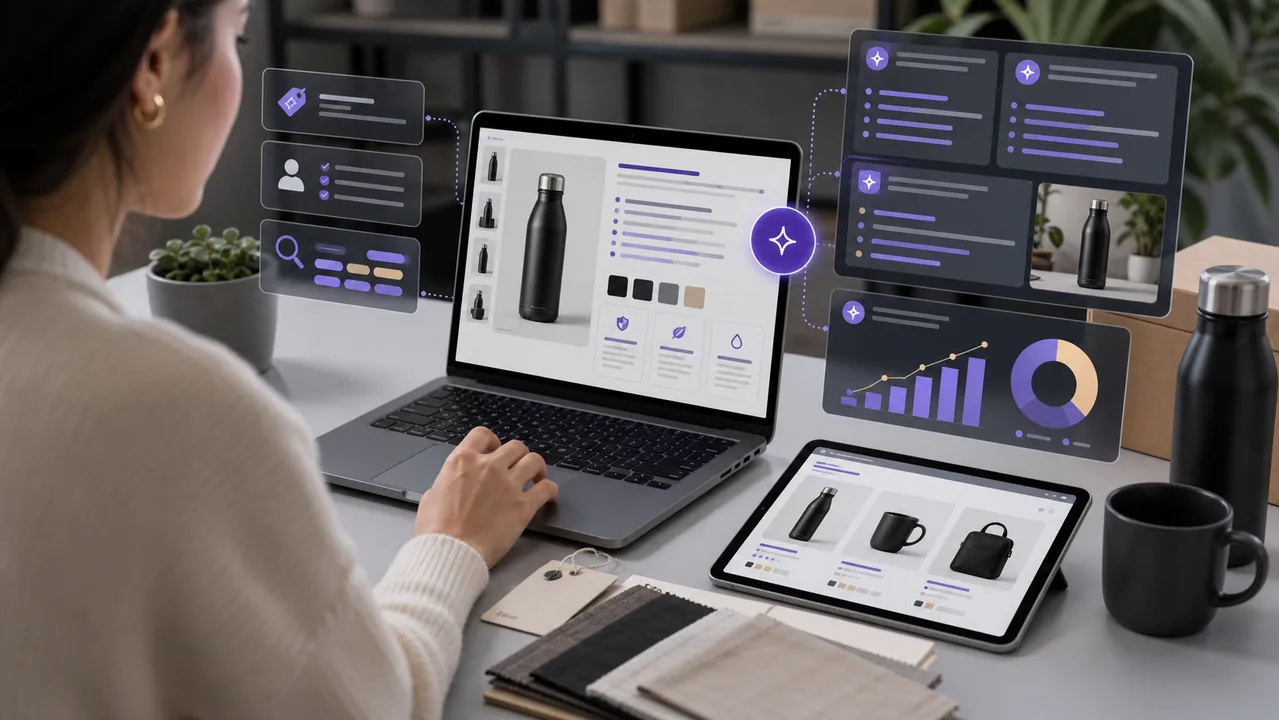
What an AI Product Description Generator Should Do
A useful AI product description generator turns raw product facts into customer-ready copy. It should explain what the product is, who it is for, why it matters, and what details reduce purchase hesitation.
The weak version writes fluffy lines like “premium quality for everyday use.” The useful version asks about material, size, compatibility, care, objections, shipping constraints, and the reason a shopper would choose this item over another.
My short rule: use AI to create the first draft and variant angles, then edit the proof, specifications, and claims by hand.
For search visibility, product copy should also support structured product information. Check product pages against Google’s product structured data guidance so the copy and page details do not fight each other.
Best AI Product Description Generator Tools
The best tool depends on where the product copy will live. A Shopify merchant needs fast listing copy. A marketplace seller needs keyword control. A brand team needs consistent voice across hundreds of SKUs.
| Tool | Best fit | Why it works | Watch-out |
|---|---|---|---|
| Shopify Sidekick / product editor | Fast ecommerce listing drafts | Good for simple product pages when you need a quick starting point. | It still needs brand voice, proof, and product-specific details. |
| Copy.ai | Marketing teams testing angles | Useful for generating multiple benefit-driven versions from the same product facts. | Some outputs can feel too sales-heavy unless you constrain tone. |
| Jasper | Brand-controlled ecommerce copy | Stronger fit when brand voice and repeatable marketing workflows matter. | Teams should create examples first, or the voice can drift. |
| Hypotenuse AI | Bulk product descriptions | Useful for catalog-heavy stores that need many product pages refreshed. | Bulk output needs sampling checks so errors do not spread across many listings. |
| Semrush: SEO research companion | Keyword and search research | Use separate SEO research to inform approved catalog copy. | This entry does not confirm a currently available dedicated product-description app. |
For a small store, first check the product editor already included in your platform. Compare specialist subscriptions only when your catalog workflow needs additional controls, exports or scale.
An Illustrative Product Copy Workflow
This is a proposed editorial workflow for a hypothetical water bottle, not an AIListPrime product test. The examples do not establish any measured improvement in sales, rankings or model output.
- Create a fact record: link each material, dimension, lid type, cleaning instruction and warranty statement to a supplier record or approved specification.
- Mark unknowns: if insulation time or cup-holder fit has no verified measurement, require the draft to mark it as missing. Do not replace the gap with a plausible number.
- Draft for a buyer: choose one use case, such as a commute, then ask for a short description and clearly separated feature bullets.
- Review every claim: compare the generated sentences with the fact record. A benefit such as leak resistance needs support even when the model adds it without being asked.
- Approve the variant: check that size, color, price and stock on the landing page correspond to the product being submitted. Keep a named reviewer and version history.
For a pilot, record editing minutes, rejected claims and customer questions still unanswered. If you later run an A/B test, describe the traffic split, duration and result; a sample workflow alone supports no conversion claim.
AI Product Description Examples
Here is the practical difference between generic AI copy and useful ecommerce copy. The better version does not sound louder. It answers a shopper’s real question.
| Product | Weak AI draft | Better direction |
|---|---|---|
| Water bottle | Premium bottle for daily hydration and outdoor adventures. | Focus on leak resistance, cup-holder fit, cleaning, insulation time, and commute use. |
| Linen shirt | Stylish shirt made with comfortable fabric for any occasion. | Explain fabric weight, fit, breathability, care, shrinkage risk, and when to size up. |
| Desk lamp | Modern lamp with great lighting for work and study. | Describe brightness levels, eye comfort, desk footprint, cable length, and setup use cases. |
| Skincare serum | Powerful serum that gives glowing skin. | Stay careful with claims. Mention texture, routine step, skin type fit, and patch-test guidance. |
AI ecommerce copy needs a product data layer
The best workflow is not prompt-only. Create a small product data layer first: specs, buyer objections, claims allowed, claims banned, care instructions, and proof points.
Then let AI create copy from that data layer. This prevents the tool from filling gaps with guesses.
For large catalogs, I would add a review field for “missing proof.” If the AI wants to mention durability, certification, sustainability, or performance, it should mark the needed source before the copy goes live.
How to Choose an Ecommerce Copywriting Tool
Choose based on workflow, not only output quality. The best product listing generator is the one that fits how your catalog actually gets created and maintained.
Pick a tool that creates clean short descriptions, bullet points, and meta descriptions without making claims you cannot support.
Prioritize keyword control, title variants, and concise feature bullets. Marketplace shoppers scan fast.
Look for bulk generation, spreadsheet workflows, and review sampling. One bad pattern can affect hundreds of pages.
Choose brand voice controls and examples. Luxury, technical, and handmade products need different copy rhythms.
For more AI workflow ideas, use the AIListPrime AI Guides category. If you want deeper tool-level breakdowns, check AI Tool Reviews.
Product Description Generator Pitfalls
The biggest problem is not bad grammar. It is confident copy that quietly invents features, guarantees, or product benefits.
- Invented specifications: Never let AI guess dimensions, materials, certifications, ingredients, capacity, or warranty terms.
- SEO stuffing: A product page with repeated keywords reads poorly and can weaken conversion.
- Generic benefits: If the copy works for every product, it works for no product.
- Missing compliance checks: Health, beauty, supplement, and finance products need careful claim review.
- Bulk copy errors: Review a sample from every product type before publishing hundreds of AI-generated descriptions.
Practical tip: create a “do not claim” list before generating copy. Include banned words, unsupported benefits, regulated claims, and competitor comparisons you cannot prove.
A Practical AI Product Description Prompt
Use this prompt when you want stronger product copy without giving AI room to invent details.
Write product description copy for .
Buyer: [who buys it and why].
Product facts: [material, size, color, capacity, compatibility, care, warranty].
Primary use case: [where and how it is used].
Customer objections: [fit, durability, cleaning, price, shipping, safety].
Brand voice: [plain, premium, playful, technical, minimalist].
SEO keywords to use naturally: [keywords].

Rules:
- Do not invent specs, certifications, guarantees, ingredients, or performance claims.
- Give me a short description, 5 feature bullets, a meta description, and 3 title variants.
- Mark any missing fact that would improve the copy.
- Keep the tone specific and easy to scan.
After generating, compare every claim against your product data. If the AI says something your product page cannot prove, delete it.
Current publishing checks for product copy
Facts checked October 3, 2026. Google’s October 1 AI-content guidance requires accuracy and review. This includes page metadata and structured data, not just the visible description.
Shopify’s current instructions use Sidekick and the product editor for generated descriptions. Text generation requires desktop admin; it is not supported on iPhone or Android. Merchants remain responsible for generated claims.
For Merchant Center feeds, Google’s product data specification requires structured_title and structured_description for AI-generated text, with digital_source_type set to trained_algorithmic_media. This is a feed requirement, separate from on-page Product JSON-LD. Retain required provenance metadata on generated product images.
Google’s Search changelog records the end of FAQ rich results on May 7, 2026. Keep buyer questions when they help readers; do not sell FAQ schema as an extra search display.
Catalog release checklist
- Block publication when an identity, compatibility or safety-related fact remains unresolved.
- Review every generated title, description and objective claim; sampling can detect a recurring pattern but does not approve unchecked records.
- Confirm variant, feed and landing-page consistency after exporting. Test the actual fields your connector submits rather than assuming it preserves provenance.
- Track reader-facing value: clearer care guidance, verified dimensions and compatibility answers are more useful than longer interchangeable copy.
Use the Product structured-data guide for the page markup and the Merchant Center specification for the feed. Validate each separately.
AI Product Description Generator FAQ
What is the best AI product description generator?
Shopify’s product editor and specialist copy platforms are options; Semrush is included here for separate SEO research. The best choice depends on catalog size, SEO needs, and brand voice control.
Can AI write product descriptions for Shopify?
Yes. AI can create first drafts for Shopify product pages, but you should verify specs, claims, care details, and shipping-related information before publishing.
Are AI product descriptions good for SEO?
They can help when you provide real buyer keywords and product details. They hurt when the copy repeats keywords or sounds too generic.
Should I use AI for bulk product descriptions?
Only after review and approval of generated claims and product data. Sampling helps find patterns but does not verify every listing or replace record-level checks.
Next Step
Pick one underperforming product page and rewrite it with the prompt above. Compare conversion objections, SEO keywords, and product facts before you scale the workflow across your catalog. Bookmark AIListPrime AI Guides for more practical AI tool workflows.