
Hands-on comparison
Sapling vs ZeroGPT: AI Detector Test
I sent one hand-written repair story and one deliberately generic AI-style paragraph through both detectors. The false-positive result changed the winner.
Sapling vs ZeroGPT: the tested verdict
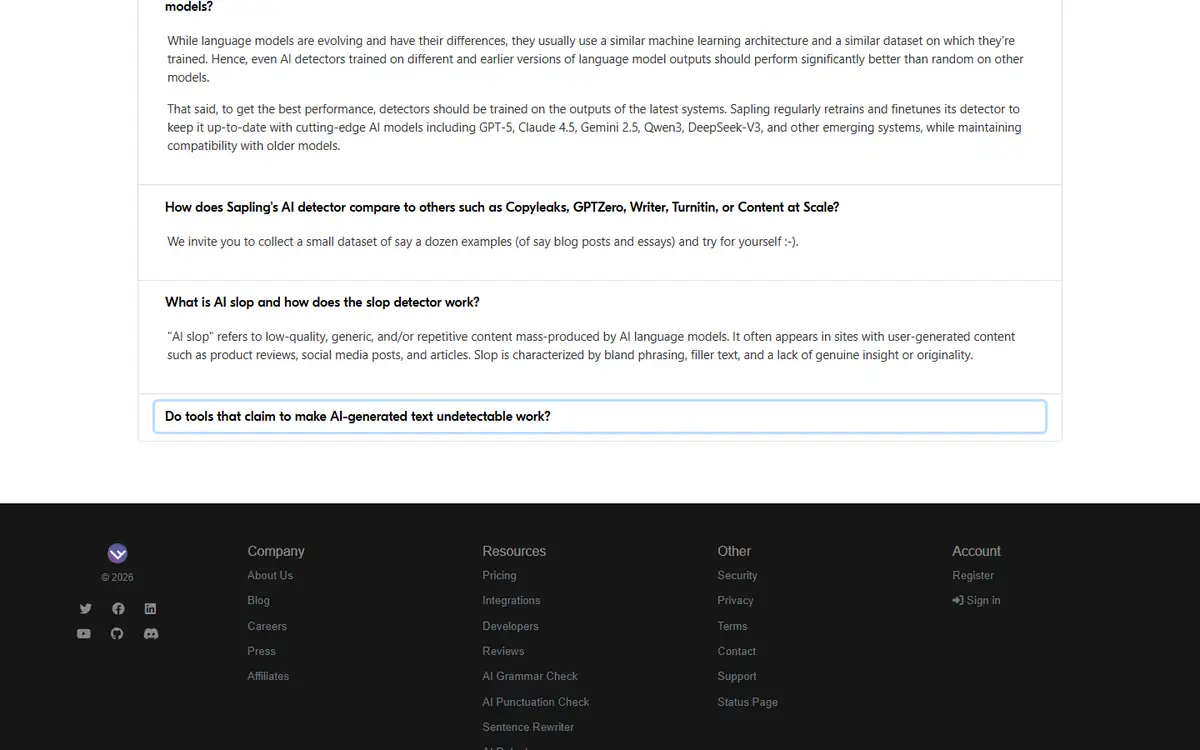
Sapling labeled the human repair story “Fake: 100.0%” and the AI-style sample “Fake: 73.6%.” That inversion is a critical failure for this pair of samples.
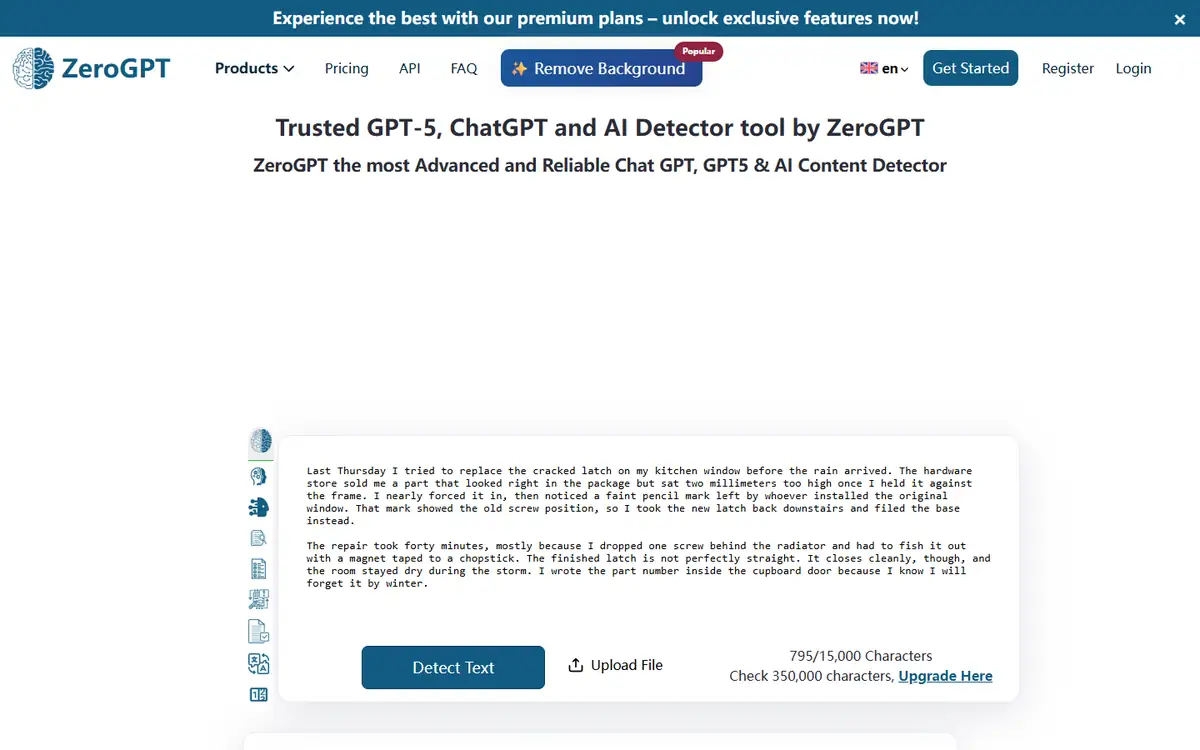
ZeroGPT gave the AI-style sample 100% AI and the human story 62.1% AI. It ranked the sources in the right order but still produced a damaging false positive.
It separated the samples better, yet a 62.1% AI score on human writing is still unacceptable for punishment.
Do not use either detector to accuse a student, reject a writer, or remove content without process evidence and human review.
How I tested Sapling vs ZeroGPT
I ran this comparison on July 28, 2026 in a clean, logged-out Chrome session at 1440 by 1050 pixels. Both tools received the same input, and I timed the usable result rather than the first animation or loading state.
The human passage contained concrete repairs, awkward detail, and a personal sequence. The AI-style passage used balanced claims, generic transitions, and no unique experience.
- Submit both samples without paraphrasing or formatting changes.
- Record the top-level probability and label.
- Check whether the human sample receives an AI score above 50%.
- Judge ranking accuracy separately from absolute accuracy.
I did not test adversarial humanizers. The practical question was simpler: can the detector avoid falsely flagging ordinary human prose?
Sapling vs ZeroGPT test results
| Test area | Sapling | ZeroGPT | Decision impact |
|---|---|---|---|
| Known human sample | 100.0% fake | 62.1% AI | Both produced a serious false positive. |
| Known AI-style sample | 73.6% fake | 100% AI | ZeroGPT ranked the samples correctly. |
| Source ranking | Incorrect | Correct | Sapling was more confident on the human text. |
| Decision use | Second opinion only | Second opinion only | Neither score proves authorship. |
Sapling’s human score was not a near miss. It was the maximum displayed probability, which would create false certainty in a disciplinary workflow.
ZeroGPT’s label text softened the human result, but the 62.1% number remains easy to misuse when copied into a report.
Sapling test: strengths and tradeoffs
Sapling made the submitted text and top-level probability easy to see. That transparency helped reveal the failure.
Its result order was the opposite of what a reliable detector should produce on these two samples.
Where Sapling did well
- Fast public test
- Visible token count
- Shareable result interface
Where Sapling fell short
- 100% false-positive score on human prose
- Lower score on the AI-style sample
- No safe enforcement interpretation
I would not use Sapling for a consequential authorship decision based on this test.
ZeroGPT test: strengths and tradeoffs
ZeroGPT correctly gave the AI-style sample the higher score and highlighted suspected text.
The human result still crossed an intuitive 50% threshold, which shows why an apparently correct ranking is not enough.
Where ZeroGPT did well
- Correct relative ranking
- Clear highlighting
- AI-style sample reached 100%
Where ZeroGPT fell short
- Human sample received 62.1% AI
- Label and percentage can conflict
- Easy to overinterpret
ZeroGPT is the less-bad screening signal here, not an authorship judge.
Sapling vs ZeroGPT quality: what changed the outcome
AI detection is a classification problem with asymmetric harm. A false accusation often costs more than a missed AI-assisted passage.
Short samples, edited AI text, non-native writing, formulaic business prose, and constrained assignments can all change detector behavior.
- Use the exact same input and settings for both tools.
- Score task completion before judging polish.
- Count manual fixes, blocked steps, and failed exports.
- Repeat one edge case instead of trusting a single ideal sample.
A useful evaluation needs known-origin documents from the same genre and writers as the future workload.
Sapling vs ZeroGPT pricing and free access
I checked the public entry points and pricing language during the test. I did not treat a prominent free label as proof that the complete workflow was free.
The useful unit is a finished task: an export, an answer set, or a file that can be used outside the editor. A free preview that stops before that point has limited buying value.
| Buying question | Sapling | ZeroGPT |
|---|---|---|
| Can the test start without an account? | See tested result | See tested result |
| Can a usable result be exported? | Verify at the final step | Verify at the final step |
| Are limits based on files, words, or credits? | Check live plan | Check live plan |
| Does the plan renew automatically? | Check checkout | Check checkout |
I would run one representative job before subscribing, then divide the monthly price by the number of outputs that actually pass review. That number is more honest than a per-credit headline.
Sapling vs ZeroGPT privacy and data handling
The test material was synthetic or already public. I did not upload client records, private drafts, identity documents, or unreleased media.
For production use, the practical questions are retention, model-training use, deletion controls, subprocessors, and whether a team plan changes those terms.
- Use a disposable sample before sending confidential material.
- Remove names, account numbers, hidden metadata, and tracked changes.
- Confirm whether deleting a project also deletes source files and generated derivatives.
- Record the policy version used for a regulated workflow.
A polished result does not reduce the sensitivity of the source. If the input would be risky in an ordinary support ticket, it is risky in an AI tool too.
Recheck the official Sapling page and the official ZeroGPT page before uploading confidential material or paying. Product limits and policy language can change after this test date.
Who should use Sapling or ZeroGPT?
Sapling is best for
- Researchers collecting non-consequential signals
- Editors comparing several detectors
- Teams testing known-origin corpora
ZeroGPT is best for
- Reviewers who want sentence highlighting
- Writers checking how formulaic a draft appears
- Teams using scores only to prioritize manual review
Who should use neither tool
- Teams that need a signed data-processing agreement before any test.
- Users who cannot independently verify the output.
- Workflows where a missed fact, altered edge, or false label creates legal or safety risk.
Schools and employers need process evidence such as version history, source notes, and interviews, not a single detector number.
Sapling vs ZeroGPT: final buying decision
ZeroGPT wins the narrow ranking test because it scored the AI-style passage higher than the human story.
The false-positive rate means the practical recommendation is still “neither as a final decision maker.”
- Choose the tool that completes your real task with fewer corrections.
- Treat sign-in walls, CAPTCHAs, and export limits as part of the product.
- Keep a manual verification step for high-impact work.
- Retest after a major model, editor, or pricing update.
Use detector scores only as prompts for review, preserve authorship evidence, and never punish someone from one percentage.
For more hands-on comparisons, visit the AI tool comparisons hub.
Sapling vs ZeroGPT FAQ
Which was more accurate, Sapling or ZeroGPT?
ZeroGPT ranked the two known-origin samples correctly, but it still gave human writing a 62.1% AI score.
Can AI detectors prove who wrote a text?
No. They estimate patterns and can produce false positives, especially on short or formulaic writing.
What should schools use instead?
Combine version history, citations, drafts, interviews, and assignment-specific evidence with any detector signal.
Next step
Before adopting a detector, test at least 20 verified human documents from your own users and measure false positives first.