
Hands-on comparison
Sapling vs ZeroGPT: AI Detector Test
In an October 26 retest, both detectors separated one public-domain human passage from one new AI-written passage. The July screenshots tell a different, equally limited story.
Sapling vs ZeroGPT: the tested verdict
These percentages are the tools’ displayed model estimates, not a measured probability that a person cheated or the share of words an AI wrote. The public-domain passage is a 1911 novel excerpt that may differ sharply from a modern student’s or client’s draft.
Do not accuse, reject or penalize someone from either score alone.
How the October detector retest worked
On October 26, 2026, we used fresh logged-out Chrome contexts at 1440 × 1050 and submitted the same two English passages, unchanged, to both public text forms. We waited for the result and saved the visible output and screenshots. No paid dashboard, file batch or adversarial paraphrasing was tested.
- Human source: the first 160 words of Chapter I of Frances Hodgson Burnett’s The Secret Garden (1911; public-domain US edition), beginning “When Mary Lennox was sent” and ending “out of sight as much as possible.” Input SHA-256:
9921329ed99b36731d1ca45e6f209dd44e3fc22376009f75d3e4246d94daf341. - AI source: a new, unedited 154-word fictional garden passage written by an AI assistant for this test. Input SHA-256:
aa2ab46d9602dfba2ba20ae6273f689f5d827bc4047064f510b6cdb4a050822f. Its full text is below. - We recorded the top-level label and score, rather than equating highlighted words or marketing accuracy claims with ground truth.
Read the AI-written test passage
At the edge of the old manor, Mara found a garden gate hidden behind a wall of ivy. The iron latch had rusted shut, but a narrow gap remained between the posts. She slipped through and stepped into a courtyard where weeds covered the stone path. A broken fountain stood in the center. Someone had left a small watering can beside it, though the metal looked too clean to have been there long. Mara picked it up and noticed damp soil beneath the handle. She had expected the garden to be abandoned, yet the traces suggested that another visitor had come recently. Near the far wall, three new shoots pushed through the earth in a neat row. She decided to return the next morning with a notebook and a camera. Before leaving, she closed the gate as carefully as she could, then marked the place on her map so she could find it again.
October 26 result table
| Known origin | Sapling public page | ZeroGPT public page | Meaning |
|---|---|---|---|
| Human novel excerpt, 160 words | 19.1% AI estimate | Human written; 12.9% AI | Both placed this human example below the AI example. |
| New AI-written fiction, 154 words | 98.4% AI estimate | AI/GPT generated; 100% AI | Both flagged this AI example. |
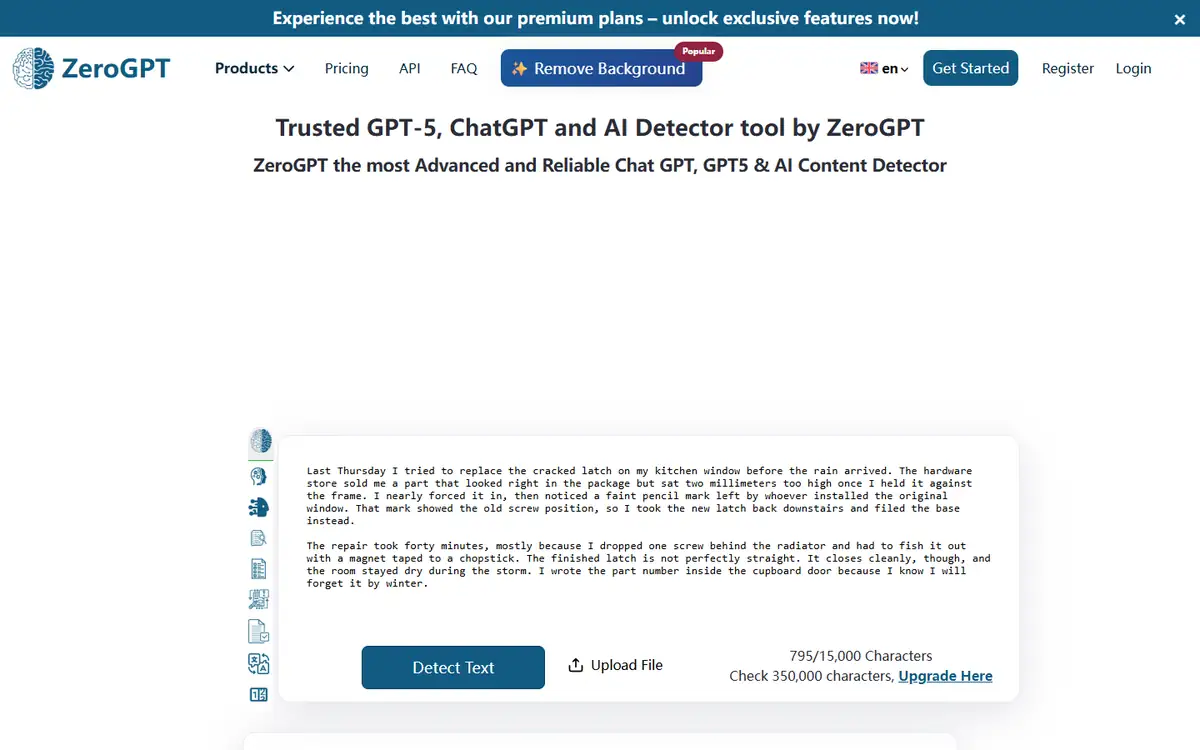
| July 28 archived, different passages | Human story: 100.0% “Fake” | Human story: 62.1% AI | Shows why a score must be dated and checked against the actual input. |
The July and October passages differ, so the changed percentages cannot measure model improvement. The old page’s fixed “ZeroGPT wins” conclusion from July is too broad for a buyer today.
Sapling: what the current test shows
Sapling’s public editor accepted both passages and displayed 184 and 176 tokens respectively. The scores were 19.1% and 98.4%. Its page explicitly says false positives and negatives are possible and that no detector should be used as a standalone origin check.
Its changelog describes a September 17 model update, then multilingual additions on October 9 and 13. These are vendor-reported changes, not independent proof of a particular accuracy rate. The public page says its free check covers the first 2,000 characters; the Pro path has different limits.
ZeroGPT: what the current test shows
ZeroGPT accepted the same 820- and 831-character passages in its logged-out text form. It labeled the novel excerpt “Human written” at 12.9% AI and the AI passage “AI/GPT Generated” at 100%. The form displayed a 15,000-character maximum. We did not export a PDF or use its paid batch tools.
ZeroGPT’s method page itself calls its results probabilistic. Its stated overall accuracy and false-positive rate are vendor claims whose datasets are not reproduced in this two-text test.
What detector scores cannot prove
The relevant purchasing question is how often a tool falsely flags verified human work from your actual genre, length, language and editing process. A public-domain novel and one AI draft cannot answer that. Published text may also be familiar to training data, while an edited or translated draft changes the task.
- Build a consented, known-origin sample set from the workflow you plan to review.
- Measure false positives separately from missed AI writing.
- Preserve version history, notes and sources before interviewing a writer about a flag.
- Document the detector, date, language and input length; repeat after model updates.
Free access and plan limits
The October checks used each vendor’s public text page without a paid account. Sapling says its free page checks the first 2,000 characters; ZeroGPT’s text box showed 15,000 characters. Those are per-check display limits, not a promise of unlimited monthly throughput.
Read Sapling’s current detector terms and ZeroGPT’s pricing page before buying. API, file batches, reports and retention may have separate terms. We did not test a paid plan or quote a regional price.
Privacy and responsible use
The test inputs were public-domain fiction and a disposable AI passage. No student submission, client draft or private record was uploaded. For real documents, verify consent, retention, deletion, access controls and appeal procedures before sending text to either service.
When a result matters, a writer’s drafts and source trail are more useful than an unexplained percentage. Keep a human review path and let the subject respond to a specific concern.
Who should use each tool?
Sapling fits
- Quick, small text checks where its explicit limitations are visible
- Teams planning to evaluate known-origin samples first
- Editors who want a supplementary flag, not a verdict
ZeroGPT fits
- Users who want a longer public text entry box
- Reviewers who find highlighted passages useful for follow-up
- Teams that independently validate vendor claims
Neither is suitable as a sole gate for education, employment or publishing sanctions.
Decision workflow
No current winner follows from four scores. In the October pair, both made the expected distinction. In the separate July pair, each produced a concerning human false positive. Choose an interface only after testing representative, permissioned documents and setting a process for contested flags.
- Collect verified human and AI-assisted examples of similar length and genre.
- Run both tools under the same conditions and record displayed scores.
- Calculate false-positive counts before deciding any review threshold.
- Use drafts, sources and conversation to resolve a flagged case.
For more focused tool research, visit the AI tool comparisons hub.
Sapling vs ZeroGPT FAQ
Which detector was more accurate in the October retest?
Both separated one known human passage and one AI-written passage in this limited test. That is not an accuracy rate or a reason to use either score as authorship proof.
Why do the new scores differ from the July screenshots?
The October retest used different passages and Sapling has since documented model updates. The July images remain a dated record; they are not a matched before-and-after model benchmark.
Can an AI detector prove a student or writer cheated?
No. Preserve drafts, revision history, sources and the writer’s explanation; investigate context before any consequential decision.
Next step
Start with ten or more verified human samples from the actual workflow, then review each flag with its draft history before expanding the test.