
Decision-focused comparison
Frase vs Surfer SEO: Content Brief Comparison
Use one search-intent brief and one existing URL to decide which documented workflow your editor needs. No live Frase–Surfer test or ranking outcome is claimed.
Frase vs Surfer SEO: the editorial decision
The earlier page reported a July 30 test and declared a measured brief winner without saved outputs. This revision is a documentation-based comparison plus a protocol for a future test. Neither tool’s score is a ranking promise.
A content-brief pilot an editor can reproduce
Proposed, unperformed case: brief an article for a property manager evaluating an AI chatbot for apartment-maintenance requests. This query can mix software roundups, resident-support products and broad chatbot explainers. The desired page is a buyer decision aid, not a generic AI overview.
- Freeze the brief. Record target reader, job, query, desired page type and one business action. Use identical inputs in both tools.
- Classify the live results. Label each prominent result as buyer comparison, product page, explainer, forum or unrelated. Note why a result is excluded.
- Build two drafts. Export the tool-generated outline, suggested questions and source list before editing. Record account plan, settings and any feature unavailable in the trial.
- Mark evidence needs. Flag response-time claims, tenant satisfaction, integrations, pricing and privacy as requiring current primary evidence or direct testing.
- Blind-review the briefs. Remove tool names and scores. Have an editor count missing buyer questions, unsupported claims, redundant headings and correction minutes.
- Repeat for a live URL. Ask each product for a conservative refresh of one existing article; compare proposed changes and rollback controls without auto-publishing.
Keep the inputs, exported briefs, edits and reviewer notes. No output or time measurement from this protocol is asserted here.
Documented capabilities and pilot questions
| Decision point | Frase | Surfer SEO | What to verify |
|---|---|---|---|
| New brief | Research, draft, SEO/GEO scoring and publishing in one content loop | Content Editor and integrations support writing or optimization | Does the exported brief answer the buyer’s actual questions? |
| Existing URL | Audit-page allowance and Content Guard page monitoring vary by tier | Discovery tracks 10 pages; higher tiers add more monitoring and controls | Which proposed change is evidence-backed and reversible? |
| AI visibility | Starter tracks ChatGPT and Google AI; additional engines vary by tier | Discovery focuses on drafting; Standard adds 25 prompts refreshed weekly | Does the purchased tier include the engines and cadence needed? |
| Governance | CMS connection and optional agent publication require permission design | Score, editor and monitoring need editorial review | Who approves the final claim and can roll it back? |
These are Frase and Surfer documented surfaces, not a measured speed or quality ranking.
Where Frase may fit—and the review burden
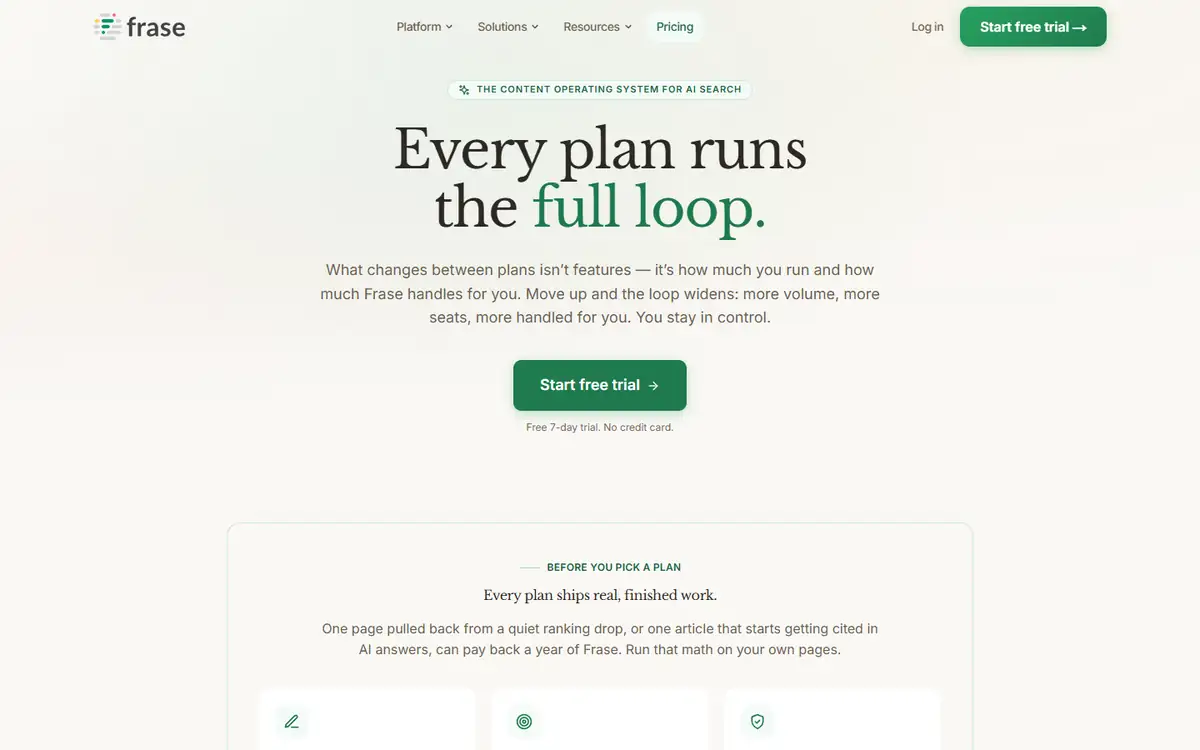
Frase’s current plan page combines research, AI drafting, SEO/GEO scores, audits, CMS publishing and Content Guard. Starter includes one seat and one site; it is plausible for a small team that needs a linked brief-to-refresh workflow. Its agent can publish when enabled, while Content Guard approval is the default unless changed.
Tradeoff: a fast draft can carry the wrong page type or an unsupported claim into a connected CMS. Start with approval on, least-privilege credentials and an exported brief. Ask who owns the evidence behind every suggested section.
Where Surfer SEO may fit—and the score risk
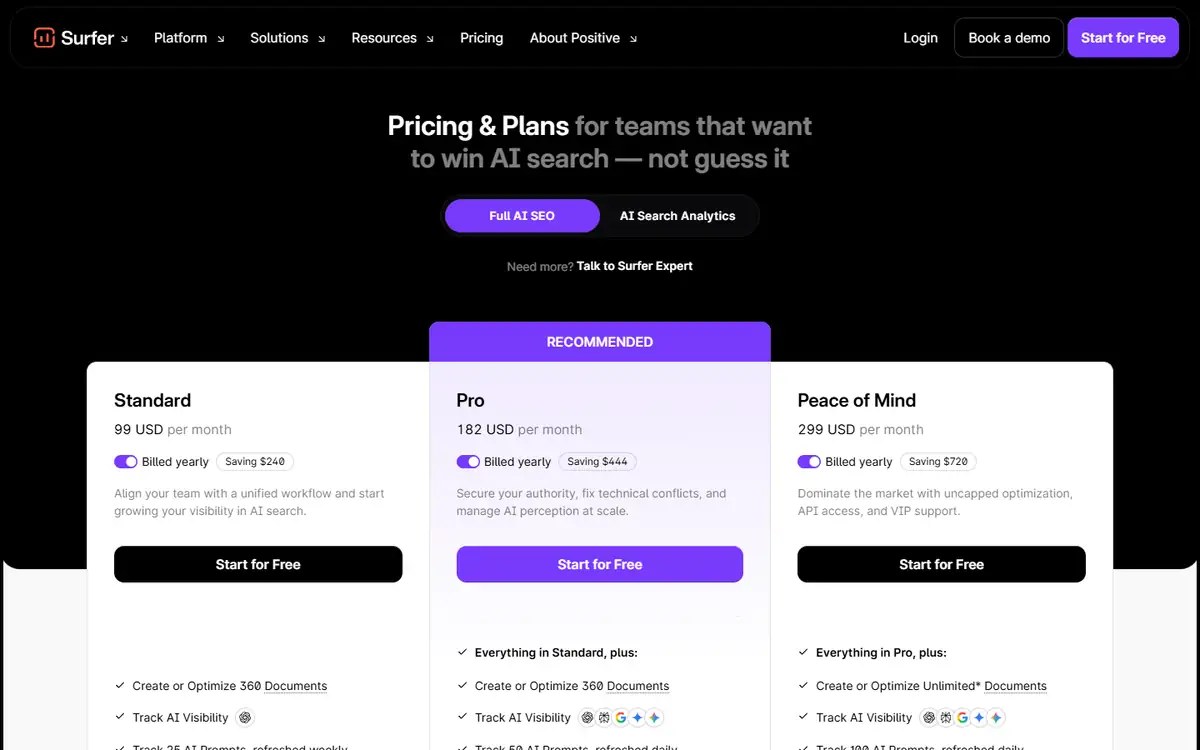
Surfer’s current Standard tier describes Content Editor, 360 create-or-optimize documents, weekly AI-prompt tracking, integrations, collaboration and rank-drop detection. Pro adds stronger portfolio features such as internal linking, coverage gaps and cannibalization reporting. Discovery is a smaller entry tier with 120 documents and 10 tracked pages.
Tradeoff: optimization guidance can tempt a writer to add a term that the buyer does not need. Compare a score-blind brief with the scored draft and delete unsupported or irrelevant recommendations. Confirm which features are present in the exact purchased tier.
When neither article brief is the right deliverable
A local or transactional query may call for a product page, category page, comparison table or tool, not a long article. Record the observed page types before accepting either product’s default structure. If forums dominate, identify questions they leave unresolved rather than copying their language.
For the apartment-maintenance example, a specialist integration page may be relevant even when it is an outlier among generic AI articles. Exclude a result with a written intent reason, not solely because it changes the average score.
Count approved work, not generated words
For a fictional month of ten new assignments and fifty existing-page checks, count approved briefs, audit pages, tracked URLs, editor correction time and seats. Frase Starter’s published allowance maps directly to ten articles and fifty audit pages, but a second seat or additional site changes the plan. Surfer Discovery’s document and tracked-page units are different, so a headline price is not a cost-per-approved-brief result.
Annual prices are monthly equivalents billed for a year. Record renewal, limits and optional extras before a purchase. A larger document allowance can still create a costly backlog of pages no one can maintain.
Five acceptance checks for the brief
- The brief names the target property-management buyer, their decision and the page type.
- Each proposed section is marked essential, evidence-required or optional; irrelevant SERP patterns are explained.
- All product, performance, integration and pricing claims have a current source or an explicit test requirement.
- An editor can remove the optimization score and still understand the outline and next action.
- The team can identify the account plan, reviewer, CMS permission and rollback copy.
Failing a check means revise the brief. Passing it is editorial readiness, not proof of Google ranking gains.
Current plans and access checked October 17
Frase pricing lists Starter at $39/month equivalent billed yearly or $49 month to month, with one seat, one site, ten articles and fifty audit pages each month. Professional is $103/$129 and Scale $239/$299 on the yearly/monthly views. The 7-day trial is capped at five articles and fifty audit pages. Optional pay-as-you-go is off by default on Professional and Scale.
Surfer pricing lists Discovery at $49/month equivalent billed yearly, with 120 create-or-optimize documents and ten tracked pages. Standard is $99/month equivalent billed yearly, with 360 documents and 25 AI prompts refreshed weekly. Pro is $182/month equivalent billed yearly and adds deeper portfolio tools. The separate $82 AI Search Analytics offer is a different package; do not compare it as the writing plan.
Check the live billing selector, allowance reset and required features for the actual account before purchase. Neither vendor’s marketing page proves a ranking result for this site.
Draft, analytics and CMS permissions
Both workflows may receive unpublished copy, analytics and brand guidance. Use non-sensitive sample material in a trial. Review the selected account’s processing, retention and connector permissions before adding client data.
If a CMS is connected, give the tool only the permission needed for the pilot, keep a separate revision copy and require a human review for claims or high-impact changes. Do not treat an AI-generated citation as verified evidence.
Keep editorial decisions outside the tool
Export the target intent, briefs, cited source list, content inventory and pre-refresh versions. A new tool can replace the optimization interface without erasing the reason each URL exists. Rebuild monitoring and approval rules separately when moving platforms.
Who should pilot Frase or Surfer?
A conditional buying decision
For the specific buyer brief, start with a Frase pilot if the team’s missing layer is research-to-assignment. Start with a Surfer pilot if writers already have a strong brief but need consistent optimization and monitored refreshes. The final decision requires the same brief, a score-blind editorial review and actual plan access.
No product won a live trial in this article. Read the Frase and Surfer plan pages, then run the six-step protocol with a reviewer.
For adjacent choices, visit the existing AI tool comparisons hub.
Frase vs Surfer SEO FAQ
Which should a small team pilot for a new content brief?
Frase is a reasonable first pilot when research, drafting, audits and CMS publishing must share one workflow. Compare the same editor-approved brief in Surfer before committing.
Does Surfer Content Score guarantee a ranking?
No. A score is an optimization signal, not proof that a page satisfies intent, contains original evidence or will rank.
How do the current entry plans differ?
Frase Starter is $39/month equivalent billed yearly, with 10 articles and 50 audit pages monthly. Surfer Discovery is $49/month equivalent billed yearly and lists 120 documents plus 10 tracked pages; check each plan selector and reset rules.
Did AIListPrime run a paid head-to-head test?
No. This update compares current official documentation and gives a reproducible pilot for an editor to run. It reports no measured speed or ranking result.
Primary sources and scope
Reviewed October 17, 2026: Frase current plans and workflow; Surfer current plans and features. Product pages support listed features and prices, not unperformed results. Paid accounts, SERP outputs and ranking impact were not tested for this revision.
Next step
Create one blind brief in each tool, remove the scores, and let an editor choose. Track briefing time and deleted recommendations before committing to an annual plan.