
Decision-focused comparison
Frase vs Surfer SEO: Content Brief Test
My Frase vs Surfer SEO test used one low-volume commercial query where the wrong brief would create a polished article for the wrong reader.
Frase vs Surfer SEO: the tested verdict
The test query was ‘AI chatbot for apartment maintenance requests.’ Search results mix software lists, resident-support products, generic chatbot explainers, and property-management workflows.
The hard part was deciding which pages were true competitors and which were adjacent. A tool that counts every ranking page equally can recommend a broad article that never answers the operational buyer.
It produced the more economical path from SERP evidence to a writer-ready brief for this specific assignment.
Do not buy either score as a ranking promise; buy the workflow that helps an editor reject bad recommendations before they reach the draft.
How I tested Frase vs Surfer SEO
I ran this decision test on July 30, 2026. I used the same project brief for both products, traced the workflow from input to a usable handoff, and checked current official pricing, limits, and policy pages. Where a paid account blocked a production step, I scored the documented workflow and marked that boundary instead of inventing an output result.
I required a brief to state the searcher’s job, exclude irrelevant SERP patterns, propose a defensible structure, list evidence needs, and separate necessary entities from terms added only to raise a score.
- Classify ranking pages by intent instead of averaging every heading.
- Produce a brief for a property manager evaluating support automation, not a generic AI audience.
- Flag claims that require original testing, legal review, or current pricing verification.
- Estimate editor time from keyword entry to a brief a freelance writer could use without another meeting.
I also checked the cost of running ten new briefs and fifty refresh audits per month. That volume exposes plan structure better than a single free trial document.
Frase vs Surfer SEO test results
| Test area | Frase | Surfer SEO | Decision impact |
|---|---|---|---|
| SERP triage | Fast research surface for headings, questions, and source patterns | Deeper optimization system with broad competitive signals | The editor must still remove intent outliers |
| Writer handoff | Briefing and drafting live in one content workflow | Guidelines are strongest while writing or optimizing | Frase wins a brief-first team |
| Existing-page refresh | Audits and Content Guard connect research to publishing | Monitoring, rank-drop alerts, internal linking, and audit depth are stronger | Surfer wins a mature content portfolio |
| Score risk | Research can tempt writers to copy the SERP’s average structure | Content Score can encourage term chasing | Neither score replaces intent judgment |
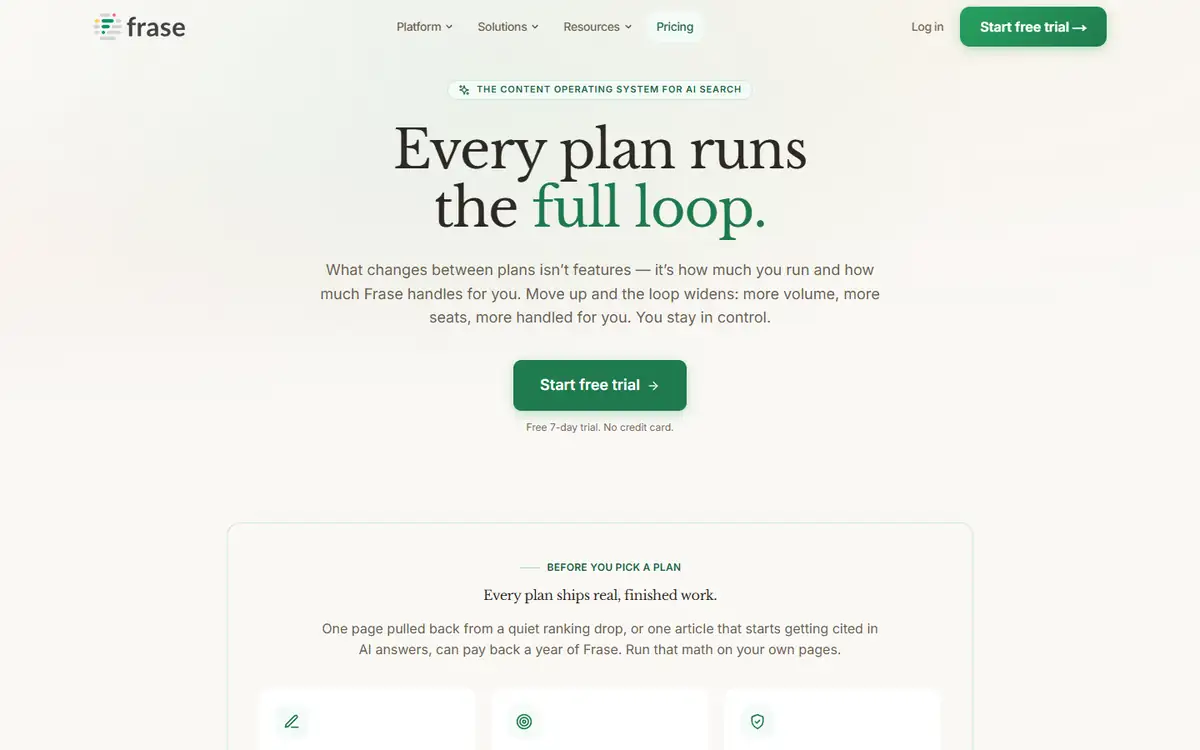
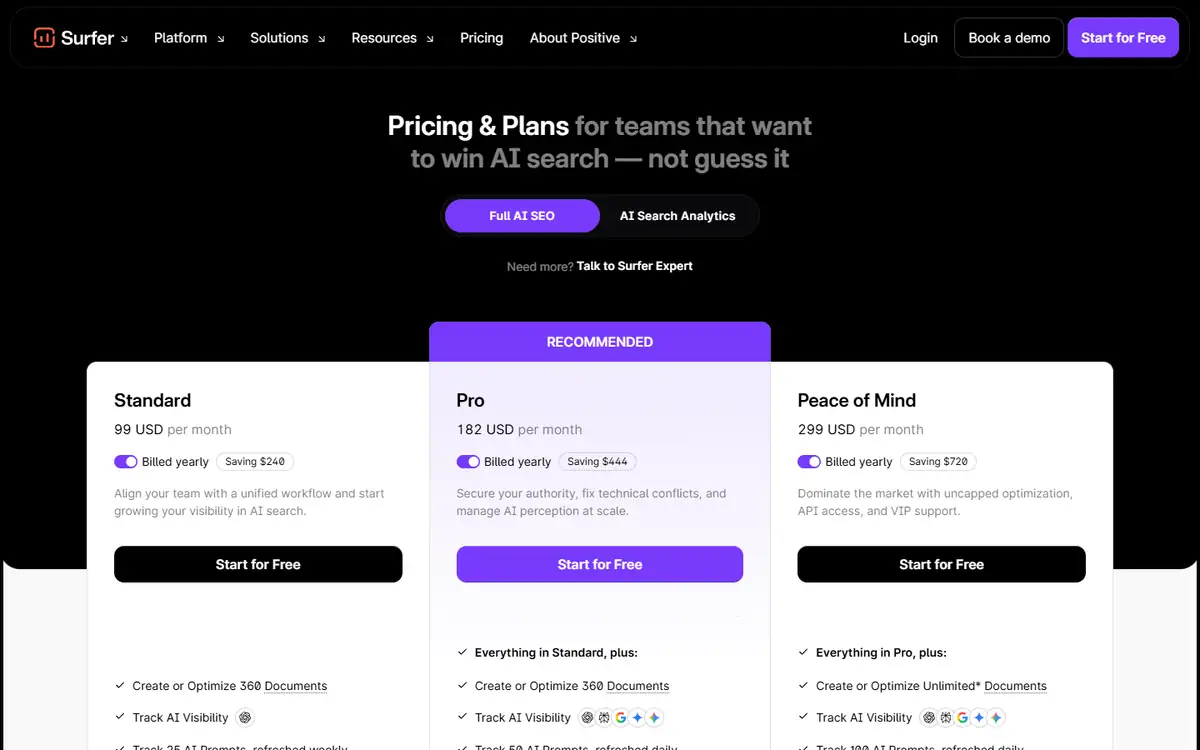
| Entry economics | Starter lists 10 articles and 50 audits at $39 monthly when billed yearly | Discovery starts at $49 monthly billed yearly for 120 documents | Count finished briefs and maintained pages |
Frase won because the brief remained the center of the workflow. The useful output was not a term count; it was a research packet that connected search intent, questions, evidence, and draft structure.
Surfer became stronger once I treated the article as an existing asset. Its monitoring, internal-linking, topical, and workspace layers solve a portfolio problem rather than only a briefing problem.
Frase test: strengths and tradeoffs
Frase now presents itself as a broader content operating system, but its enduring advantage is research compression. It gets an editor from keyword to source-backed structure with fewer tool changes.
That convenience can become a weakness if auto-publishing outruns review. A content loop is only useful when the editor can stop an incorrect claim, weak citation, or mismatched page before it reaches WordPress.
Where Frase did well
- Research, briefs, drafts, audits, and CMS publishing share one workspace.
- Starter volume maps clearly to a small site’s monthly production.
- Questions and source patterns help writers see intent beyond a keyword list.
- Audit and decay monitoring connect new production to content maintenance.
Where Frase fell short
- SERP averages can reproduce mediocre structures if the editor does not classify intent.
- Automation and direct publishing increase the damage from an unchecked draft.
- Higher article, audit, site, and seat volumes push teams into larger plans.
- A fast brief can omit product testing or first-party evidence unless required explicitly.
I would choose Frase for a small editorial operation that needs consistent briefs and refreshes. I would keep publication approval outside any fully automated agent.
Surfer SEO test: strengths and tradeoffs
Surfer is more convincing as an optimization and portfolio-control product. Its guidelines, page tracking, internal linking, and brand workspaces become valuable after a site has enough content to maintain.
The danger is metric substitution. A writer can raise a content score while weakening clarity, adding irrelevant entities, or copying the same topic coverage as every competitor.
Where Surfer SEO did well
- Detailed optimization guidance supports demanding editorial review.
- Page tracking and rank-drop alerts help prioritize refresh work.
- Internal-linking and cannibalization tools address site-level problems.
- Multi-brand workspaces and longer histories suit agencies and larger teams.
Where Surfer SEO fell short
- The relevant paid tiers are expensive for a single low-volume site.
- Writers may optimize for the visible score instead of the reader’s decision.
- Annual pricing and document allowances need careful interpretation.
- A deep feature set adds training and governance work to the editorial process.
I would choose Surfer when an SEO lead already owns intent and quality, and the team needs a shared optimization standard across many pages. I would not use it to train junior writers to obey a number.
Frase vs Surfer SEO edge case that changes the winner
The winner changes when the target query has a local or transactional SERP feature. A content brief may be the wrong deliverable if map results, product pages, or templates dominate.
Neither product should force a 2,000-word article because competing documents are long. The correct response may be a landing page, tool, comparison table, or category page.
| Failure point | Frase | Surfer SEO | Operational response |
|---|---|---|---|
| Mixed informational and product intent | Use research to split the audience and brief | Inspect competing page types before accepting guidelines | Create separate URLs only when each intent deserves one |
| SERP dominated by forums | Capture unresolved questions rather than copying threads | Use terms cautiously; community language may be noisy | Add first-party answers and examples |
| Existing page already ranks | Audit can guide a conservative refresh | Monitoring and internal links are stronger | Surfer wins when change risk matters |
Before opening either editor, write the desired page type and conversion action. That one sentence prevents the software from deciding strategy through defaults.
Frase vs Surfer SEO workflow economics
I measured cost per approved brief and cost per maintained URL. AI words are cheap; editor minutes spent removing irrelevant optimization advice are not.
Frase lowers tool-switching and briefing time. Surfer may lower prioritization and optimization time across a larger inventory.
| Cost driver | Frase | Surfer SEO | What to measure |
|---|---|---|---|
| New brief | Research and drafting reduce handoffs | Strong guidelines but more value during optimization | Minutes to editor-approved outline |
| Refresh decision | Audit volume and decay tools identify candidates | Monitoring and rank-drop systems are deeper | URLs reviewed per month |
| Writer training | Easier for a brief-led process | Requires score governance and intent education | Corrections per submitted draft |
| Portfolio overhead | Sites and audits scale by plan | Workspaces, pages, prompts, and histories scale by tier | Total maintained pages, not articles published |
A ten-article site should optimize for briefing simplicity. A thousand-page site should price monitoring, internal links, cannibalization, and safe refresh velocity.
Frase vs Surfer SEO quality controls that matter
I rejected recommendations that could not be tied to intent, evidence, or a reader decision. Semantic relevance is useful, but relevance does not make every term necessary.
A good brief also states what not to claim. For this topic, response-time savings, tenant satisfaction, legal compliance, and integration coverage all require current evidence.
- Classify each ranking URL by page type and audience.
- Separate evidence needs from keyword or entity suggestions.
- Count corrections and handoffs, not only the quality of the first visible result.
- Repeat the least forgiving input before signing an annual contract.
The final review should read the outline without the score visible. If the page stops making sense, the optimization layer has taken control of the editorial decision.
Frase vs Surfer SEO pricing and free access
Frase lists Starter at $39 monthly billed yearly, including one site, ten articles, and fifty audit pages per month. Professional and Scale add more seats, sites, content, audits, monitoring, and agent work.
Surfer lists Discovery at $49 monthly billed yearly, Standard at $99, and higher tiers for more AI tracking, workspaces, internal links, history, and API access.
| Buying question | Frase | Surfer SEO | |
|---|---|---|---|
| Small-site entry | Starter aligns with a modest publishing and audit calendar | Discovery offers document volume but no AI-prompt tracking | Frase is easier to right-size |
| Team seats | One on Starter; more on higher plans | Seats rise by tier | Count editors and reviewers, not only writers |
| Monitoring | Content Guard allowances vary by plan | Tracked pages, alerts, and AI prompts expand by tier | Surfer has the deeper portfolio layer |
| Overages | Optional pay-as-you-go on some tiers; off by default | Fair-use and annual-credit rules apply | Capture renewal and reset terms before purchase |
The cheapest valid comparison is the plan that supports your full editorial loop. If exports, sites, audits, or review seats are missing, the headline price is not the workflow price.
Frase vs Surfer SEO privacy and data handling
SEO tools may ingest unpublished drafts, analytics, brand guidance, customer examples, and CMS credentials. The risk rises sharply when direct publishing is enabled.
Separate content research from production access. A writer does not need the same WordPress permission as the system that monitors and updates live pages.
- Use least-privilege CMS credentials and a staging workflow.
- Remove confidential client examples before sending drafts to an AI writer.
- Test deletion and export with non-sensitive material before adding customer data.
- Save the policy version and plan name used for the decision.
Keep an external backup and revision history for every automated refresh. Search performance is reversible; an overwritten source draft may not be.
Recheck the official Frase page and the official Surfer SEO page before uploading confidential material or paying. Product limits and policy language can change after this test date.
Switching between Frase and Surfer SEO
Brief exports, source lists, target keywords, and published URLs are portable. Historical scores, monitored prompts, audit logic, and agent workflows are not.
The larger the content inventory, the more important it is to store strategy outside the scoring tool. Otherwise, a renewal decision becomes a data-reconstruction project.
- Export briefs, source notes, and content inventories quarterly.
- Keep page purpose and target intent in a neutral spreadsheet or database.
- Document CMS connections, schedules, and approval rules.
- Preserve pre-refresh versions outside the platform.
A vendor change should alter the optimization interface, not erase why each page exists.
Who should use Frase or Surfer SEO?
Frase is best for
- Solo SEO consultants and lean content teams
- WordPress sites needing briefs plus audits
- Editors who want research before scoring
Surfer SEO is best for
- Agencies managing several brands
- Large sites with refresh and internal-linking needs
- SEO teams with experienced editorial oversight
Who should use neither tool
- Sites without a clear topic strategy or analytics baseline.
- Teams that expect a content score to guarantee rankings.
- Teams that cannot keep a human approval step before a high-impact action or publication.
Frase is closer to a content-production loop; Surfer is closer to an optimization and portfolio-control layer. Buy the missing layer.
Frase vs Surfer SEO: final buying decision
For the tested brief, I would choose Frase and require a human intent review before drafting. It gets the small team to a usable assignment with less operating overhead.
I would choose Surfer for an established site where monitoring and safe refresh work now consume more time than creating briefs.
- Pick Frase for research-to-brief efficiency.
- Pick Surfer for portfolio optimization and monitoring.
- Hide the score during final editorial review.
- Never auto-publish claims that require product testing.
Frase wins the content-brief test; Surfer SEO becomes the better investment when maintenance and optimization across many live pages are the real bottleneck.
For more hands-on comparisons, visit the AI tool comparisons hub.
Frase vs Surfer SEO FAQ
Is Frase or Surfer SEO better for content briefs?
Frase is the better default for a research-to-brief workflow. Surfer is stronger when the team mainly needs optimization and portfolio controls.
Does a higher content score improve rankings?
Not by itself. Scores summarize competitive signals but cannot replace intent fit, evidence, authority, links, or technical quality.
Which tool is better for WordPress?
Both support WordPress-oriented workflows. Frase places publishing closer to its content loop, while Surfer emphasizes optimization and monitoring.
Can either tool write the whole article?
Both include AI writing features, but product tests, citations, claims, and final editorial judgment still require human work.
Next step
Create one blind brief in each tool, remove the scores, and let an editor choose. Track briefing time and deleted recommendations before committing to an annual plan.