
Decision-focused comparison
Consensus vs Elicit: Literature Review Test
This Consensus vs Elicit comparison follows one evidence question from a fast answer through screening, structured extraction, and an audit-ready source table.
Consensus vs Elicit: the tested verdict
I used a deliberately difficult question: whether asynchronous four-day workweeks reduce burnout without lowering output in knowledge-work teams. The phrase mixes intervention design, subjective outcomes, and business performance, so shallow keyword matching fails.
Consensus gets to a useful evidence map faster. Elicit creates more review machinery, which feels slower until the project requires screening reasons, custom columns, and a clean handoff to another researcher.
It wins the complete review task because the workflow continues from search into screening and structured extraction rather than stopping at a persuasive answer.
Consensus helps decide what the literature appears to say; Elicit helps build the evidence table needed to defend how you reached that view.
How I tested Consensus vs Elicit
I ran this decision test on July 30, 2026. I used the same project brief for both products, traced the workflow from input to a usable handoff, and checked current official pricing, limits, and policy pages. Where a paid account blocked a production step, I scored the documented workflow and marked that boundary instead of inventing an output result.
The acceptance test required a reproducible search trail, at least three exclusion reasons, extraction of population and intervention details, and citations that resolve to the actual paper rather than a secondary summary.
- Find recent human workplace studies and separate trials from surveys or opinion pieces.
- Exclude studies about compressed clinical shifts that do not match knowledge work.
- Extract sample, setting, schedule design, burnout measure, productivity measure, and limitations.
- Produce a source table that a second reviewer can challenge without rereading an AI narrative.
I scored retrieval relevance, visibility of study design, control over inclusion, exportability, and the labor needed to correct an extraction. I did not score the confidence of the prose.
Consensus vs Elicit test results
| Test area | Consensus | Elicit | Decision impact |
|---|---|---|---|
| Question framing | Natural-language exploration is fast and encourages useful follow-ups | Works best once the review question and criteria are more explicit | Consensus wins the scoping phase |
| Study-design visibility | Snapshots and filters make design easier to inspect | Custom columns can encode design and eligibility in the review table | Elicit is stronger for repeatable screening |
| Screening trail | Collections help organize papers, but the answer remains the center | Dedicated systematic-review workflow supports larger screened sets | Elicit wins auditability |
| Extraction repair | Good for inspecting individual sources and asking follow-ups | Column-by-column extraction makes errors easier to spot and replace | Structured errors are cheaper to correct |
| Final deliverable | Strong cited synthesis | RIS, CSV, BIB, PDF, and DOCX exports on paid plans | Choose by narrative versus evidence table |
Consensus was the better first hour. Its paper search, study snapshots, filters, and cited synthesis help reveal whether the question is too broad, whether evidence clusters around one population, and where disagreement sits.
Elicit was the better second day. Once exclusions and custom fields matter, a table-centered workflow prevents the review from becoming a chat transcript that only its original author understands.
Consensus test: strengths and tradeoffs
Consensus is strongest as an evidence-oriented search and synthesis surface. It helps a researcher move from a broad question to paper-level inspection without opening dozens of unrelated browser tabs.
Its 2026 additions, including expanded study-design filters, library work, deeper searches, and citation graph tools, reduce the gap with review software. The center of gravity still remains the question and answer.
Where Consensus did well
- Fast cited synthesis makes it useful for scoping and evidence checks.
- Study Snapshots expose sample, design, outcome, and duration without hiding the source.
- Advanced methodology filters can remove obvious design mismatches early.
- Collections and citation graphs support deeper follow-up after the first answer.
Where Consensus fell short
- A persuasive synthesis can be mistaken for a reproducible protocol.
- Deep-review quotas matter for researchers who iterate on many questions.
- Screening reasons and extraction governance are less central than in Elicit.
- The path from answer to a handoff-ready evidence table takes more manual discipline.
I would use Consensus before writing a protocol or answering a time-sensitive evidence question. I would not rely on the generated narrative as the only record of inclusion and exclusion decisions.
Elicit test: strengths and tradeoffs
Elicit treats papers as rows and research questions as structured work. That approach feels less immediate, but it is closer to the artifacts expected in a serious review.
The benefit appears when a reviewer needs to add an extraction field, compare studies, sort exclusions, or export work. The cost is that the user must define what deserves a column.
Where Elicit did well
- Dedicated systematic-review workflow can screen thousands of papers on higher plans.
- Custom extraction columns make assumptions visible and correctable.
- Multiple scholarly export formats reduce migration work at the end.
- Zotero import and paper-level chat fit an existing research library.
Where Elicit fell short
- The workflow rewards a well-scoped question and can feel heavy during early exploration.
- Systematic-review capacity and larger extraction limits sit on paid tiers.
- An extracted cell can look authoritative even when the source text is ambiguous.
- Researchers still need duplicate removal, protocol discipline, and independent verification.
I would start Elicit when the output must survive peer review, team handoff, or later updates. Its table is not proof of correctness, but it is a better place to expose and repair errors.
Consensus vs Elicit edge case that changes the winner
The winner changes when studies use different definitions of productivity. One paper may count tickets closed, another supervisor ratings, and another self-reported focus.
A synthesis tool can flatten those measures into ‘productivity did not decline.’ A structured extraction tool can preserve the measurement mismatch, but only if the reviewer creates the right column.
| Failure point | Consensus | Elicit | Operational response |
|---|---|---|---|
| Outcome label hides different measures | Open Study Snapshots and source text before accepting the synthesis | Create separate metric, instrument, and measurement-window columns | Do not combine outcomes until measures are comparable |
| Protocol is still changing | Better for question refinement and mapping | Changing columns midstream can create inconsistent extractions | Use Consensus first, then freeze criteria |
| Two reviewers disagree | Collections can share papers and context | Screening decisions are easier to compare in a structured workflow | Elicit wins the adjudication edge case |
The best workflow is often sequential: use Consensus to sharpen the question, then move the stable protocol into Elicit. Paying for both can be cheaper than forcing either tool to cover the wrong stage.
Consensus vs Elicit workflow economics
Research-tool cost is dominated by reviewer time. I modeled the price against hours spent finding irrelevant papers, copying study details, and resolving extraction errors.
Consensus saves the most time before formal screening. Elicit saves more time after the criteria stabilize and the paper set grows.
| Cost driver | Consensus | Elicit | What to measure |
|---|---|---|---|
| Scoping time | Lower because synthesis and follow-up are immediate | More setup before the table becomes valuable | Hours to a defensible research question |
| Screening labor | Manual discipline needed for explicit exclusion trails | Workflow is designed around screening and extraction | Minutes per title, abstract, and full text |
| Correction cost | Narrative corrections may require rechecking several cited claims | A wrong cell can be repaired without rewriting the whole review | Time from discovered error to corrected artifact |
| Plan pressure | Deep-review quotas are the constraining unit | Review-agent usage, paper limits, and extraction columns drive tier choice | Number and size of active reviews |
For five exploratory questions a month, Consensus is usually the better economic fit. For one large evidence project, Elicit’s structure can repay its higher tier through fewer manual extraction hours.
Consensus vs Elicit quality controls that matter
I checked whether every synthesis claim could be traced to a study with the right population, intervention, and outcome. Citation presence alone did not earn a point.
For extraction, I treated ‘not reported’ as a valid result. Guessing a sample characteristic from surrounding text is worse than leaving the cell visibly incomplete.
- Verify study design, population, and outcome instrument in the paper.
- Keep exclusion reasons mutually exclusive enough to analyze later.
- Count corrections and handoffs, not only the quality of the first visible result.
- Repeat the least forgiving input before signing an annual contract.
Both tools can accelerate review work, but neither resolves publication bias, weak measurement, inaccessible full text, or a poorly framed causal question.
Consensus vs Elicit pricing and free access
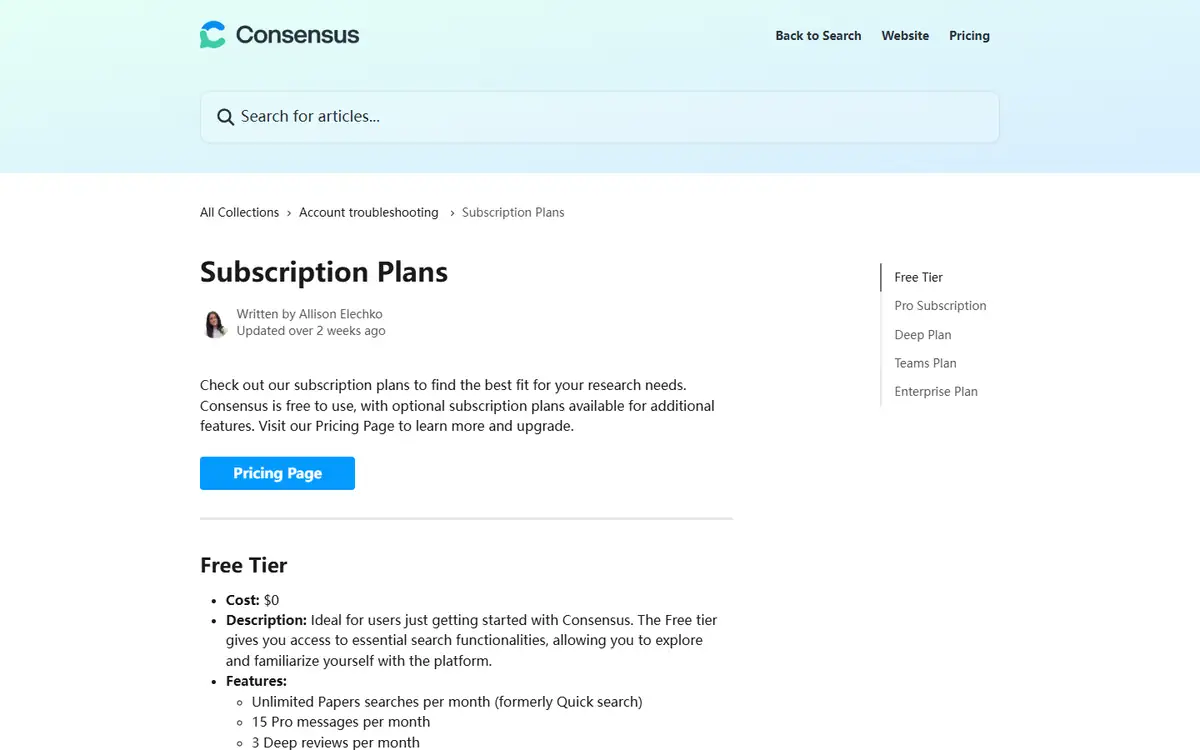
Consensus currently offers Free, Pro at $20 monthly or $144 annually, and Deep at $65 monthly or $540 annually. The key difference is the allowance for Pro messages and Deep reviews.
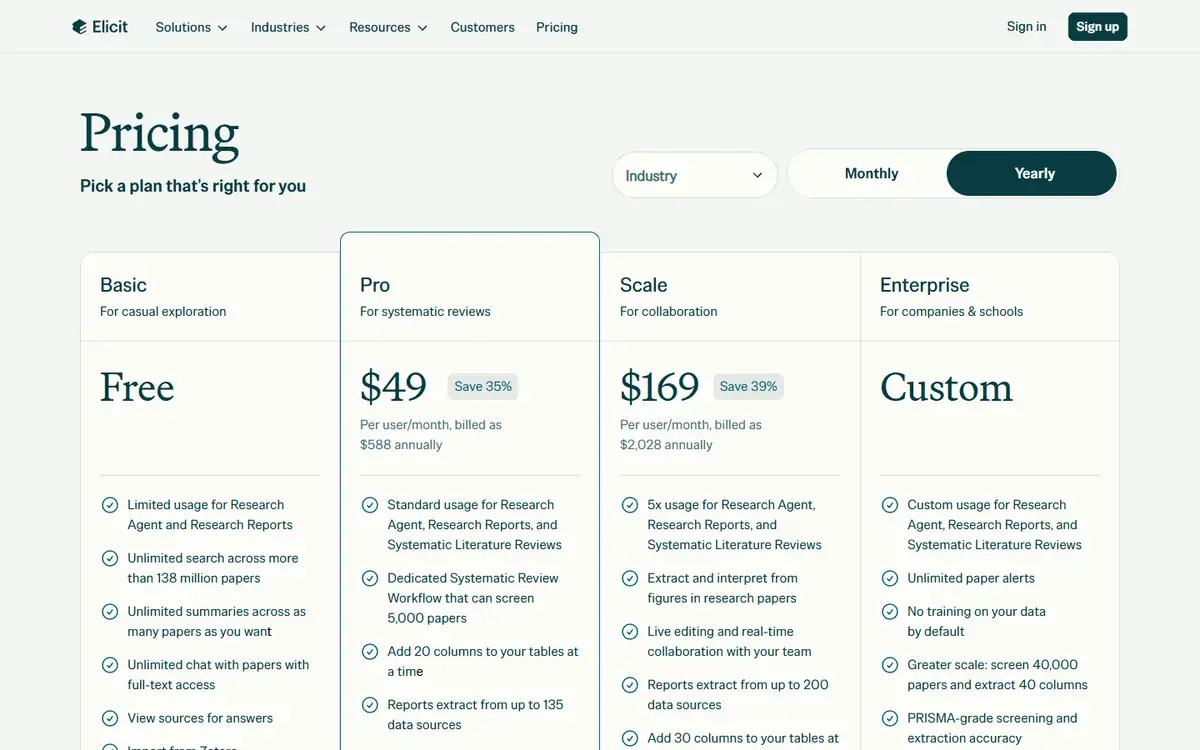
Elicit offers a free Basic tier, with paid plans that add exports, higher Research Agent usage, systematic-review screening, more extraction columns, and collaboration. The Pro workflow is the relevant comparison for a formal review.
| Buying question | Consensus | Elicit | |
|---|---|---|---|
| Useful free start? | Unlimited paper search with limited Pro and Deep messages | Unlimited broad paper search with limited agent and report usage | Both can scope a question before payment |
| Formal review capacity | Deep plan expands longer reviews | Pro and Scale unlock dedicated systematic-review volume | Elicit has the clearer review-production tiers |
| Exports | Citations and report outputs depend on mode | RIS, CSV, BIB, PDF, and DOCX on paid plans | Check the exact final format needed |
| Team governance | Custom Teams pricing | Scale and Enterprise add collaboration and controls | Do not buy individual plans for a shared protocol |
Choose a plan by the number of completed reviews, not queries. A low-cost plan that stops before screening export creates more manual work than it saves.
Consensus vs Elicit privacy and data handling
Published papers are low sensitivity, but unpublished manuscripts, peer-review notes, clinical protocols, and internal research reports are not. The input type changes the privacy decision.
Consensus documents private collections and states it does not train models on user data. Elicit’s enterprise language adds no-training-by-default and stronger controls, but individual-plan handling still deserves review.
- Separate published sources from confidential uploads in different projects.
- Confirm whether collaborators can export or reshare uploaded full text.
- Test deletion and export with non-sensitive material before adding customer data.
- Save the policy version and plan name used for the decision.
For unpublished material, obtain the required institutional approval before upload. A research convenience tool should not become an unapproved document repository.
Recheck the official Consensus page and the official Elicit page before uploading confidential material or paying. Product limits and policy language can change after this test date.
Switching between Consensus and Elicit
Citations, DOI lists, RIS/BibTeX files, and extraction CSVs are portable. Chat history, saved filters, agent instructions, and row-level provenance are less portable.
A migration becomes difficult when the only record of a judgment is a conversation. Structured criteria and standard exports keep the review independent from the tool.
- Export DOI, title, abstract, decision, reason, and extraction columns.
- Store the protocol and search strings outside the platform.
- Keep stable paper IDs so duplicates can be reconciled.
- Record which fields were AI-extracted and which were human-verified.
Do a small export at the start, not the end. The best time to find a missing provenance field is before hundreds of papers depend on it.
Who should use Consensus or Elicit?
Consensus is best for
- Students scoping a research question
- Analysts needing a fast evidence check
- Writers who want citations close to the synthesis
Elicit is best for
- Systematic and scoping review teams
- Researchers building reusable extraction tables
- Projects that require formal exports and handoff
Who should use neither tool
- Medical or policy users who would act without reading the underlying studies.
- Reviews that require a locked institutional database workflow these tools cannot document.
- Teams that cannot keep a human approval step before a high-impact action or publication.
Use the product whose primary artifact matches your deliverable: an evidence answer for Consensus, or an evidence table and review trail for Elicit.
Consensus vs Elicit: final buying decision
I would begin in Consensus to test vocabulary, identify evidence clusters, and find obvious scope problems. That reduces protocol changes after screening begins.
Once criteria are stable, I would run the formal project in Elicit and export early. The extra structure is valuable precisely because it makes uncertainty harder to hide.
- Pick Consensus for scoping and time-sensitive evidence questions.
- Pick Elicit for screened sets, extraction, and team handoff.
- Never score citation count as proof of relevance.
- Preserve ‘not reported’ instead of filling gaps with inference.
Elicit wins the complete literature-review workflow; Consensus remains the faster and often better front end for deciding what the review should ask.
For more hands-on comparisons, visit the AI tool comparisons hub.
Consensus vs Elicit FAQ
Is Consensus or Elicit better for a literature review?
Elicit is better for formal screening and structured extraction. Consensus is faster for scoping and cited synthesis.
Can Consensus and Elicit replace a human reviewer?
No. Both can accelerate retrieval and extraction, but humans must set criteria, verify sources, and judge study quality.
Which tool is better for students?
Consensus is easier for early question exploration. Elicit is more useful once the assignment requires a documented evidence table.
Can I use both tools together?
Yes. A practical sequence is Consensus for scoping, then Elicit for the stable screening and extraction workflow.
Next step
Run the same ten-paper pilot in both tools. Count irrelevant sources, unverifiable claims, extraction corrections, and minutes to an export another researcher can understand.