
Decision-focused comparison
Chatbase vs Botpress: Support Bot Test
This Chatbase vs Botpress test uses a refund question that requires policy grounding, account lookup, a safe refusal, and human handoff.
Chatbase vs Botpress: the tested verdict
The test customer asked for a refund after 35 days, claimed a damaged item, and could not provide the order email. The bot had to explain policy without inventing eligibility or changing an account.
Chatbase gets to a grounded answer quickly. Botpress takes more design work but provides a clearer place to model identity verification, exception routing, tool failure, and human ownership.
It wins the full support task because refunds and account actions require controlled state, tool calls, and escalation rather than only a good knowledge answer.
Chatbase is the better knowledge-agent product; Botpress is the better support-application platform.
How I tested Chatbase vs Botpress
I ran this decision test on July 30, 2026. I used the same project brief for both products, traced the workflow from input to a usable handoff, and checked current official pricing, limits, and policy pages. Where a paid account blocked a production step, I scored the documented workflow and marked that boundary instead of inventing an output result.
I required source citation, uncertainty language, identity verification before account access, no autonomous refund, a handoff summary, and a traceable cost per conversation.
- Answer the general return-policy question from approved content.
- Refuse to confirm order-specific eligibility before verification.
- Route damaged-item exceptions to the right queue with the source transcript.
- Handle a failed order API without looping or exposing internal errors.
I also modeled 4,000 monthly conversations because message credits, incoming events, AI spend, seats, and add-ons scale differently.
Chatbase vs Botpress test results
| Test area | Chatbase | Botpress | Decision impact |
|---|---|---|---|
| Knowledge answer | Fast ingestion and website-agent setup | Capable, but more builder configuration | Chatbase wins time to first answer |
| Stateful refund flow | AI Actions and integrations depend on plan | Visual flows, variables, tables, and code provide deeper control | Botpress wins sensitive operations |
| Human handoff | Helpdesk features begin on Standard | Human handoff is listed on Plus | Price the production tier |
| Cost model | Message-credit tiers and add-ons are visible | Plan plus provider-cost AI spend and event limits | Chatbase is simpler; Botpress is more granular |
| Failure debugging | Good analytics on higher plans | Execution logic and logs suit developers | Botpress wins operational diagnosis |
Chatbase won the first-day test because content ingestion and agent deployment are direct. That is real value for a small site whose primary task is answering approved FAQs.
Botpress won the production test. Once an answer can trigger account access, a refund, or a CRM write, explicit state and failure paths matter more than launch speed.
Chatbase test: strengths and tradeoffs
Chatbase productizes the common support-agent path: add sources, configure behavior, connect channels, review messages, and improve the knowledge base.
The path becomes expensive when voice, API, helpdesk, personalization, advanced integrations, or high message volume are required.
Where Chatbase did well
- Fast document-grounded deployment.
- Clear message-credit tiers and familiar integrations.
- Auto retraining and source suggestions on higher plans.
- Website support teams can operate it without building every flow.
Where Chatbase fell short
- Free agents are deleted after 14 days of inactivity.
- Free includes only 50 monthly message credits and a 1 MB training limit.
- Helpdesk, voice, API, and advanced integrations move to Standard.
- Removing Chatbase branding is a substantial annual add-on.
I would use Chatbase for a content-heavy support widget where answers dominate and account-changing actions remain with humans.
Botpress test: strengths and tradeoffs
Botpress gives builders a programmable conversation system. Flows, tables, code, agents, and integrations make it easier to encode what must happen when the happy path fails.
That control creates engineering work. The team owns conversation design, testing, observability, spend, and the boundary between deterministic and generative logic.
Where Botpress did well
- Visual workflow logic handles branching and recovery.
- AI spend is passed through at provider cost without markup.
- Detailed limits and add-ons allow targeted scaling.
- Developer tools support custom actions and business-system integration.
Where Botpress fell short
- Plan fee, AI spend, incoming events, storage, bots, and add-ons complicate forecasting.
- Human handoff and watermark removal begin on Plus.
- Builders can create fragile flows without testing discipline.
- A free prototype can understate production support and governance needs.
I would use Botpress when the support bot is an application with business rules, not just a search box with a conversational front end.
Chatbase vs Botpress edge case that changes the winner
Conflicting policy pages change the winner. Retrieval can return both an old 30-day rule and a new 45-day exception.
The correct response is not to average them. The system must know source priority, effective date, product region, and when to escalate.
| Failure point | Chatbase | Botpress | Operational response |
|---|---|---|---|
| Conflicting policy | Curate sources and use source suggestions | Add deterministic priority and effective-date logic | Botpress offers deeper control |
| Order API timeout | Use an integration action and handoff fallback | Branch on timeout with a stored case state | Never retry indefinitely |
| FAQ-only site | Launch speed and maintenance simplicity win | Extra builder depth is overhead | Chatbase wins the edge case |
Create a policy registry outside the prompt with owner, effective date, and superseded URL. Retrieval quality cannot fix governance the business has not defined.
Chatbase vs Botpress workflow economics
I calculated cost per resolved conversation, including human escalations and correction work. Per-message price alone rewards bots that talk longer without solving the issue.
Chatbase offers simpler tiers. Botpress can be efficient with model choice and deterministic flows, but the team must monitor several usage dimensions.
| Cost driver | Chatbase | Botpress | What to measure |
|---|---|---|---|
| Conversation usage | Monthly message credits | Incoming events plus AI token spend | Resolved cases, not messages |
| Action complexity | AI Actions and advanced integrations by plan | Code and flows can avoid unnecessary LLM calls | AI calls per resolution |
| Human handoff | Standard-level helpdesk features | Plus includes handoff | Escalation rate and handling time |
| Maintenance | Content curation and analytics | Builder, tests, logs, and integration ownership | Hours per release |
A cheaper bot that creates vague escalations can increase support cost. Include summary accuracy and duplicate-ticket rate in the pilot.
Chatbase vs Botpress quality controls that matter
I scored answer correctness, source fit, authorization boundaries, and handoff completeness. Style and speed came later.
The bot had to say what it knew, what it needed, and what a human would do next. False certainty failed even when the final policy happened to be right.
- Test missing identity, conflicting sources, and unavailable tools.
- Review every action-capable response for authorization and audit data.
- Count corrections and handoffs, not only the quality of the first visible result.
- Repeat the least forgiving input before signing an annual contract.
Keep deterministic rules for refunds, security, age, and account access. Use generation for explanation, not permission.
Chatbase vs Botpress pricing and free access
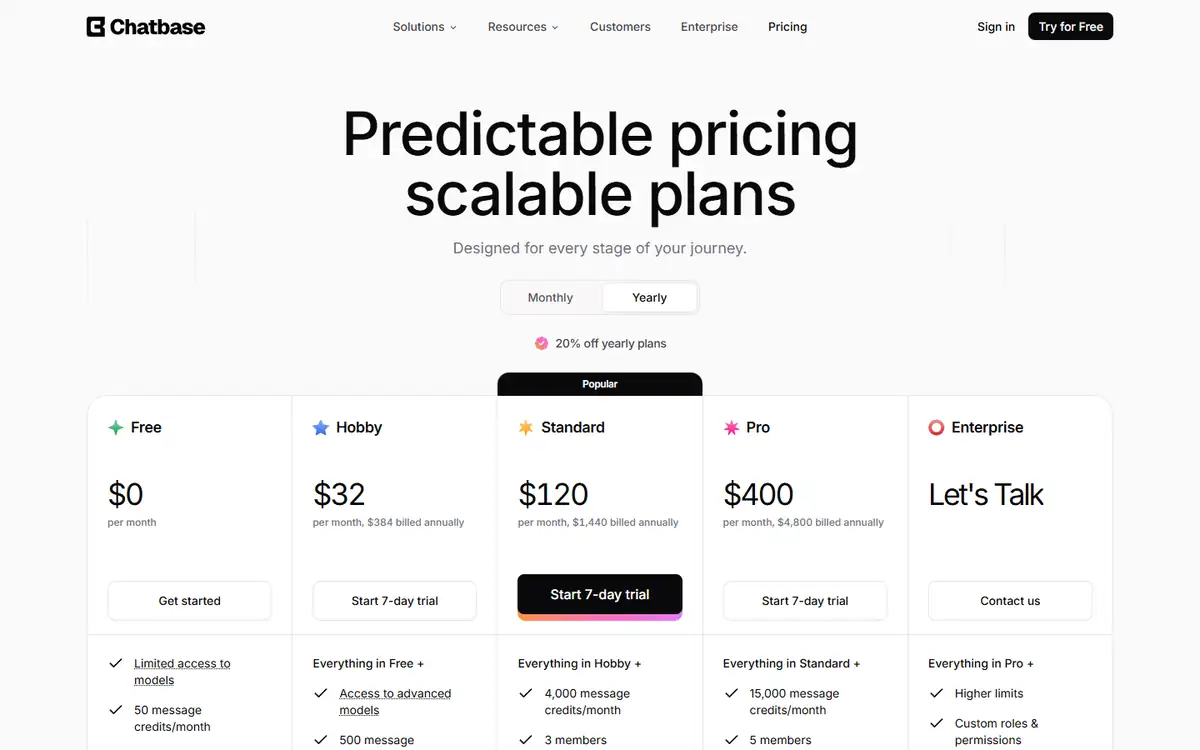
Chatbase Free includes 50 monthly message credits and one small agent. Hobby is $32 monthly billed annually; Standard is $120 and adds helpdesk, API, voice, personalization, and advanced integrations.
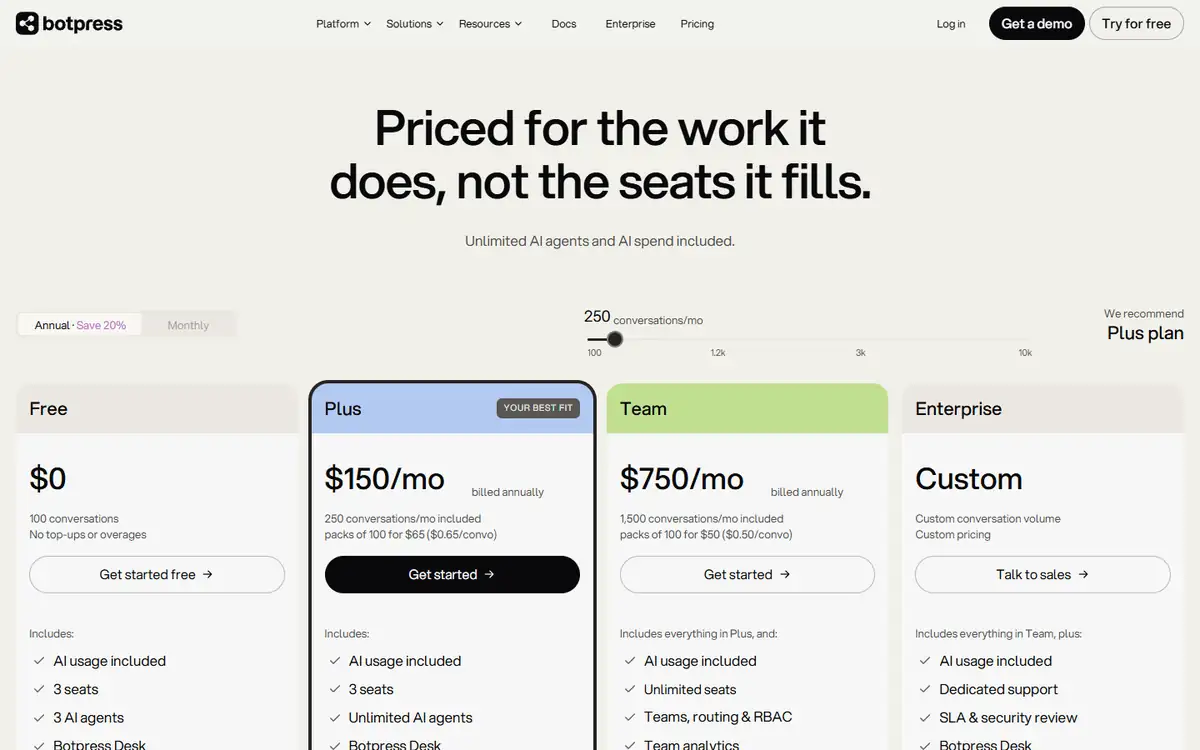
Botpress starts at $0 plus AI spend with a $5 monthly AI credit. Plus is $79 monthly billed annually, while incoming events, AI spend, bots, storage, and add-ons remain separate cost drivers.
| Buying question | Chatbase | Botpress | |
|---|---|---|---|
| Free production fit | Very small and inactive agents can be deleted | Useful for building with limited messages and AI credit | Both are pilot tiers |
| Human handoff | Standard | Plus | Compare the first operational tier |
| Variable usage | Message credits and optional auto-recharge | Provider-cost AI spend and event add-ons | Set alerts and hard caps |
| Brand removal | Separate annual add-on | Included from Plus for webchat | Relevant for client-facing deployment |
Forecast with a transcript sample: average user turns, retrieval calls, action calls, handoff rate, and peak traffic.
Chatbase vs Botpress privacy and data handling
Support data contains identities, orders, addresses, complaints, and sometimes health or payment context. The knowledge base is only the least sensitive part.
Separate public policy retrieval from authenticated account actions and keep secrets out of prompts, logs, and handoff summaries.
- Redact payment and authentication secrets before model calls.
- Limit logs, exports, and collaborator roles by support function.
- Test deletion and export with non-sensitive material before adding customer data.
- Save the policy version and plan name used for the decision.
Use synthetic traffic until access control, deletion, incident response, and human escalation are tested.
Recheck the official Chatbase page and the official Botpress page before uploading confidential material or paying. Product limits and policy language can change after this test date.
Switching between Chatbase and Botpress
Source documents and transcripts are portable. Agent prompts, actions, flows, tables, analytics, and integration state are not.
Botpress creates more potential lock-in because more application logic lives in the builder. Chatbase lock-in concentrates in agent tuning and analytics.
- Keep policies in an external source of truth.
- Document every action schema and failure branch.
- Export transcripts and evaluation sets.
- Store integration contracts in version control.
Treat the platform as replaceable orchestration around business rules the company owns.
Who should use Chatbase or Botpress?
Chatbase is best for
- Small support teams launching a knowledge agent
- Content-heavy websites with standard channels
- Operators who prefer configuration over flow engineering
Botpress is best for
- Developers building stateful support automation
- Teams integrating custom systems
- Products needing detailed branches and spend controls
Who should use neither tool
- Businesses without a maintained policy source of truth.
- Teams planning autonomous refunds without identity and authorization controls.
- Teams that cannot keep a human approval step before a high-impact action or publication.
Choose Chatbase when content is the product; choose Botpress when the conversation controls a product.
Chatbase vs Botpress: final buying decision
I would launch a low-risk FAQ pilot in Chatbase and keep every account action behind human handoff.
I would choose Botpress for refunds, order status, and authenticated workflows, then build a regression suite before production.
- Pick Chatbase for grounded answers and quick launch.
- Pick Botpress for stateful actions and custom recovery.
- Never let retrieval authorize an action.
- Measure resolved cases and safe handoffs.
Botpress wins the deep support-automation test; Chatbase remains the faster choice for a document-grounded website agent.
For more hands-on comparisons, visit the AI tool comparisons hub.
Chatbase vs Botpress FAQ
Is Chatbase or Botpress easier to use?
Chatbase is easier for a knowledge-based website agent. Botpress requires more design but supports deeper workflows.
Which is cheaper for customer support?
It depends on turns, actions, AI tokens, integrations, handoffs, and branding. Model a real transcript sample.
Can either tool issue refunds?
Both can connect actions on appropriate plans, but identity, authorization, limits, logs, and human approval must be designed.
Which tool is better for developers?
Botpress offers the stronger programmable workflow and debugging surface.
Next step
Build the same synthetic refund flow in both tools and force five failures. Choose the platform that fails safely and gives the human agent the clearest case.