
Decision-focused comparison
n8n vs Make for AI Lead Routing: Cost and Recovery
Choose a lead-routing workflow by billing unit, recovery behavior and the team that must operate it.
n8n vs Make: the Practical Verdict
For a fictional route that receives a form event, checks consent and duplicates, calls an enrichment service, classifies the lead, writes a CRM record and alerts an owner, model the normal and failed paths. A long scenario can favor n8n’s execution unit; a short connector-led flow may favor Make’s operator time. This is a documentation-based comparison, not a measured head-to-head product test.
Evidence and a Reproducible Pilot
We checked the n8n pricing page, n8n error workflow documentation, execution retry documentation, Make pricing and credit rules and Make incomplete execution guidance on October 15, 2026. No production lead data was processed for this article.
Run the same six-step sandbox drill in both tools if your team needs a real decision:
- Create synthetic lead R104 with a unique source-event ID, consent flag and expected CRM owner.
- Search the sandbox CRM before enrichment; define the stable idempotency key used on every write.
- Enrich only if the consent and duplicate rules pass. Record the provider request and price separately.
- Ask the chosen model for a fixed label set and confidence field; route malformed or low-confidence output to review.
- Simulate an enrichment timeout and a CRM response lost after a successful write. Retry deliberately and inspect both platform logs and the CRM.
- Reconcile the final lead count, alerts, credits/executions, model charges and operator minutes against expected outcomes.
n8n vs Make: Documented Differences
| Decision area | n8n | Make | What to verify in your pilot |
|---|---|---|---|
| Platform unit | Cloud plans price workflow executions with unlimited steps | Most module actions use one credit; some AI Provider actions use more | Count normal, fan-out and retry paths, not just boxes on a diagram |
| Control | Code/HTTP nodes, Cloud or self-hosting | Visual connectors, routers and filters | Which maintainer can diagnose a broken mapping? |
| Failure tools | Error workflows and failed-execution retry; saved history is plan-limited | Incomplete executions and Retry handler; storage must be enabled | Can R104 be replayed without a second CRM record? |
| Free entry | Time-limited Cloud trial or self-hosted Community Edition | 1,000 credits per month and 15-minute minimum Free interval | Does the pilot fit the actual plan? |
The documentation establishes feature and billing differences; it does not establish a universal speed, reliability or cost winner. Measure both configurations with the same inputs and downstream services.
Where n8n Fits
n8n’s plan page prices Cloud on whole workflow executions; it lists JS/Python code steps and custom API requests. Community Edition can be self-hosted, which moves hosting, patches, backup and monitoring onto the team. A technical owner can implement custom validation, record IDs and error branches, but that ownership has a real labor cost.
Useful strengths
- One primary platform unit per workflow run, regardless of ordinary step count.
- Code and HTTP nodes for unusual services.
- Error workflows can alert on failed executions.
Tradeoffs
- Cloud execution history, duration and concurrency vary by plan.
- Self-hosting needs operational support.
- Retrying a failed execution can repeat external writes unless the flow is idempotent.
n8n is a stronger candidate when the route is long or custom, and an engineer will own the failure path. Its pricing advantage is a hypothesis until the team counts actual executions and external costs.
Where Make Fits
Make’s credit guidance says most module actions count as one credit, while AI Provider actions can consume more. Router and several error-handler modules do not count, but a scenario with many bundles and downstream actions may use far more than one credit per incoming webhook.
Useful strengths
- App-first visual scenarios suit operators who own standard SaaS flows.
- Free plan has no time limit for a light pilot.
- Incomplete executions can preserve failed runs for resolution when enabled.
Tradeoffs
- Credit use grows with executed modules and fan-out.
- AI Provider credits may be variable.
- Store incomplete executions is disabled by default and storage is limited by allowance.
Make is a stronger candidate when business operators must change mappings themselves. Have the maintainer demonstrate how to enable and resolve incomplete executions before handling real leads.
The Edge Case That Can Change the Choice
A single event containing 500 fictional lead records is not equivalent to 500 independent events. In Make, downstream modules may execute for each bundle; in n8n, one workflow run can process many items, but memory, duration, rate limits and safe checkpoint design still matter. Avoid treating either vendor’s headline unit as a full cost forecast.
| Failure point | n8n question | Make question | Required evidence |
|---|---|---|---|
| Duplicate webhook | Does the workflow check source-event ID before paid calls? | Does the scenario filter or data store suppress repeat work? | Exactly one destination record |
| Enrichment timeout | Which failed execution is saved and retried? | Was Store incomplete executions enabled? | One deliberate recovery path |
| CRM wrote but response failed | Can a retry search the existing record first? | Can a resumed run avoid a second write? | Destination state, not only platform log |
Use your actual CRM’s upsert or unique-key capability where available. A source-event key, attempt ID and destination record ID should be visible in the incident record.
Workflow Economics: Work an Example, Then Replace It
Illustration, not measured usage: assume 1,000 separate lead webhooks in a month and five standard paid Make module actions per successful lead. That is approximately 1,000 × 5 = 5,000 Make credits before fan-out, errors, extra actions or variable AI Provider use. If each webhook starts one n8n production workflow, the base is approximately 1,000 n8n executions. These are different billing units and do not include model, enrichment, CRM, hosting or staff costs.
| Cost driver | n8n measure | Make measure | Also record |
|---|---|---|---|
| Platform | Production executions and plan allowance | Executed module actions and AI Provider credits | Retry and fan-out distribution |
| Model | Chosen provider/model or included feature allowance | Make AI Provider or connected model account | Tokens, requests and retries |
| Operations | Engineering and hosting time | Operator and scenario-maintenance time | Incident minutes and review queue |
Run R104 and enough representative sandbox cases to estimate the median and expensive failure path. Do not equate n8n Assistant preview credits with all model calls, or Make platform credits with a third-party model invoice.
Quality Controls for a Lead Router
- Reject events without a stable source ID or valid consent flag before enrichment.
- Search or upsert by a destination key; never rely on the platform retry alone.
- Require an allowed classification label and a confidence or review branch; keep free text out of irreversible routing rules.
- Log the requested model, vendor response, paid calls, owner decision and destination record ID within the team’s retention policy.
- Inject duplicate, delayed, malformed and out-of-order events, plus a write whose response is lost.
Five acceptance checks: one CRM record for R104; no enrichment when consent fails; uncertain AI output enters review; the operator can locate and resolve an incomplete run; and the actual monthly cost model includes p95 fan-out plus external fees. If a check fails, revise the flow and rerun the sandbox case.
Pricing and Free Access Checked October 15, 2026
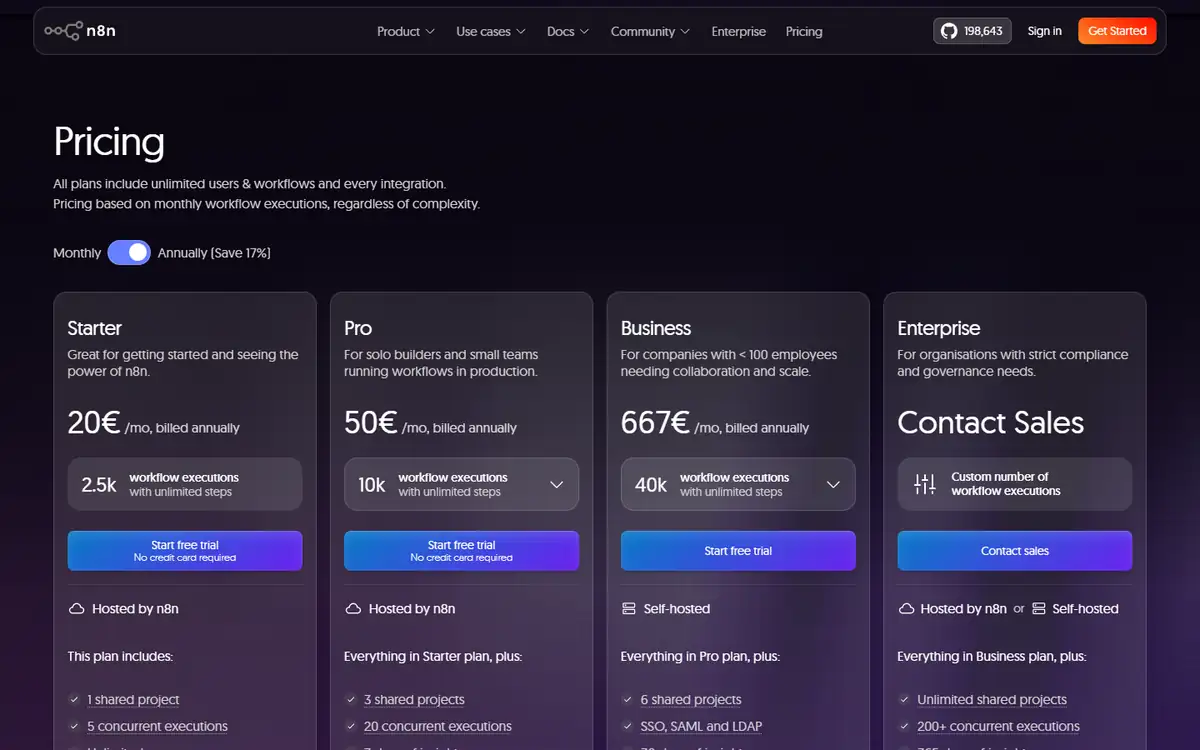
n8n lists Starter at €20/month billed annually for 2,500 workflow executions and Pro at €50/month billed annually for 10,000, with unlimited ordinary steps. The Community Edition is self-hosted; the Cloud free entry is a trial, with its own limits. Check the region, currency, billing term and current plan page before buying.
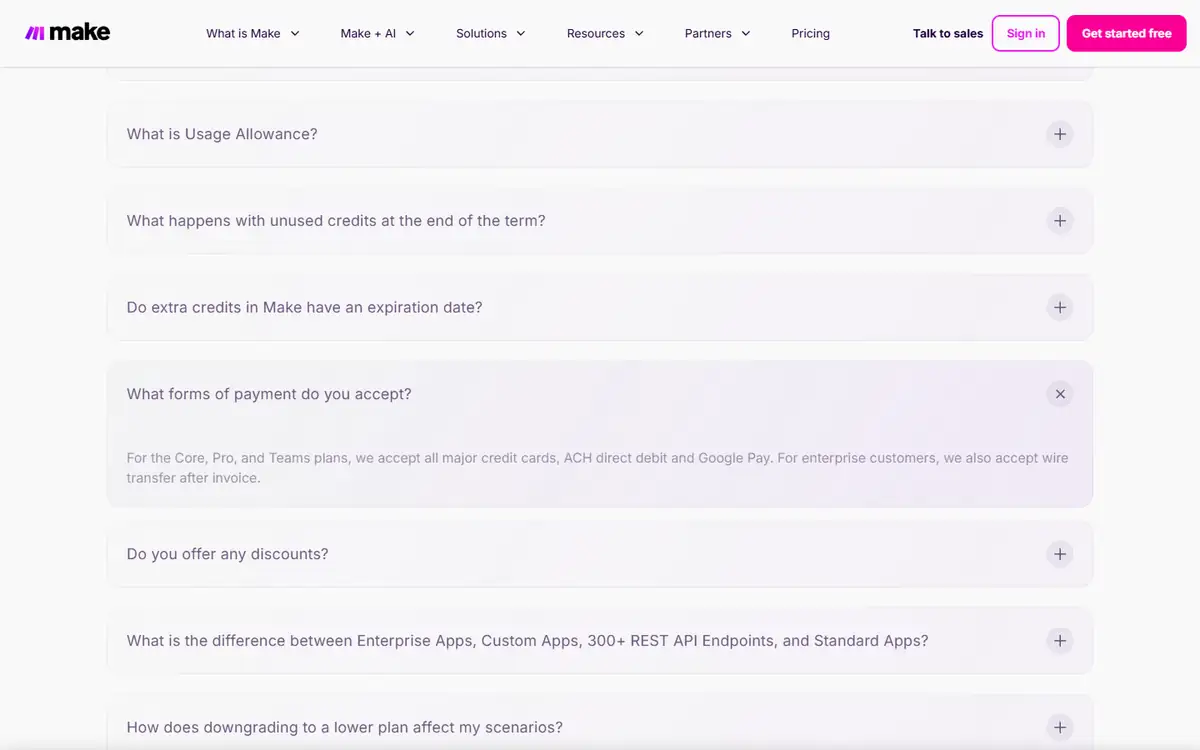
Make lists Free at 1,000 credits per month with a 15-minute minimum schedule interval. Paid tiers use an interactive credit-volume and billing selector; the old fixed $9/$16/$29 amounts on this page were removed because they did not match the currently displayed 10,000-credit selection. Check Make’s live selector for your volume and term. Unused standard credits expire at the end of the term; extra credit and annual-plan rules vary.
Privacy and Data Handling
Lead flows can expose contact details, consent state, CRM credentials and model prompts to multiple services. Self-hosting n8n changes where the workflow runs; it does not stop data from going to every configured enrichment, AI and CRM endpoint. A Make scenario likewise inherits the choices made in its connected services.
- Minimize personal fields before enrichment or model requests.
- Keep development and production credentials separate.
- Review the actual account’s data retention and execution log settings before using real leads.
- Document every processor and deletion route with the team’s own privacy reviewer.
Use synthetic data for the pilot. Do not treat this comparison as a legal determination for a particular location or contract.
Switching Between n8n and Make
Moving the canvas is less important than moving the rules. Connector mappings, credentials, saved state, error behavior and custom code may not translate directly. Keep the event schema, route decision table, sample payloads and expected CRM outcomes outside either tool.
- Export workflow/scenario versions and connector mapping notes.
- Store R104 and other synthetic regression cases.
- List secrets and owners without copying secret values into documentation.
- Run the same duplicate and failure checks after rebuilding.
Who Should Use n8n or Make?
Choose on the sandbox recovery drill and total cost, not a generic winner label.
n8n vs Make: Final Buying Decision
For a hypothetical multi-step lead router owned by engineering, n8n is the first pilot because workflow-execution pricing and code control suit the route. For a short, connector-led campaign sync maintained by operators, Make is the first pilot. Neither recommendation asserts a completed paid test.
The decision is ready only after the team demonstrates one safe R104 record, a deliberate replay path, a real billing estimate and a named incident owner. Browse other AI tool comparisons for adjacent choices.
n8n vs Make FAQ
Is n8n cheaper than Make?
It can be for long, frequently run workflows because n8n prices completed workflow executions while Make usually counts module actions. Compare the actual path, fan-out, AI usage and operator time before choosing.
Can n8n be self-hosted without a subscription?
The Community Edition can be self-hosted, but servers, upgrades, backups, monitoring and support still require resources.
Does Make retry every failure automatically?
No. Store incomplete executions is disabled by default; enable it and configure the applicable retry behavior. A retry is not a guarantee that a CRM write happens exactly once.
Which is easier for a business operator?
Make offers a visual app-first scenario builder. n8n offers more code and hosting control. Have the actual maintainer run the same sandbox recovery drill.
Next Step
Build the same sandbox route in both platforms. Replay duplicate webhooks, a timed-out enrichment call, malformed model output and a lost CRM response. Keep the one that your team can recover and maintain within its measured budget.