
Decision-focused comparison
Lovable vs Bolt: Client Portal Test
This Lovable vs Bolt test goes past the pretty first screen: the client portal needs authentication, row-level data access, uploads, audit events, and a clean code handoff.
Lovable vs Bolt: the tested verdict
The brief required invite-only login, two client organizations, document uploads, comments, status changes, and an audit trail. A user from Client A had to be unable to query Client B by changing a URL.
Both tools can produce an impressive portal shell. The decision changed when I scored authorization, schema migration, failed uploads, secret handling, and whether the generated code explained its own assumptions.
It wins the test for a technical owner because code visibility and environment control make authentication and data-boundary failures easier to diagnose.
Lovable optimizes the first mile; Bolt gives a technical owner more control over the expensive miles after the demo.
How I tested Lovable vs Bolt
I ran this decision test on July 30, 2026. I used the same project brief for both products, traced the workflow from input to a usable handoff, and checked current official pricing, limits, and policy pages. Where a paid account blocked a production step, I scored the documented workflow and marked that boundary instead of inventing an output result.
A passing app required server-side authorization, no exposed secrets, a reproducible database schema, safe empty and error states, accessible mobile UI, and a repository another engineer could run.
- Generate the portal and connect authentication plus organization membership.
- Create row-level access tests for documents, comments, and status history.
- Break an upload and database migration, then repair without rebuilding the app.
- Export or sync code, remove platform branding, and document deployment dependencies.
I counted prompts or tokens to the first secure workflow, not the first attractive screen. I also inspected how project size affects future message cost.
Lovable vs Bolt test results
| Test area | Lovable | Bolt | Decision impact |
|---|---|---|---|
| First usable UI | Guided prompts and visual edits favor polished business prototypes | Fast generation with code-first visibility | Lovable wins presentation speed |
| Authorization debugging | Guidance helps, but generated backend assumptions need inspection | Code and browser environment expose more implementation detail | Bolt wins technical diagnosis |
| Backend path | Managed cloud and common backend connections reduce setup | Database choice and code environment offer flexibility | Choose guidance versus control |
| Cost visibility | Credits vary by mode, complexity, hosting, and AI features | Tokens grow with project context; plan limits are explicit | Both become less predictable as the app grows |
| Handoff | Code ownership and GitHub workflows support exit | Code-centric environment and repository handoff fit developers | Test the export on day one |
Lovable won the stakeholder demo. It gets a nontechnical user to an attractive, coherent business interface with fewer decisions and stronger visual guidance.
Bolt won the engineering test. When an authorization rule failed, the ability to inspect dependencies, routes, queries, and environment behavior mattered more than another corrective prompt.
Lovable test: strengths and tradeoffs
Lovable reduces product decisions by guiding users toward a supported full-stack path. Visual edits and managed cloud features make iteration approachable.
Its flexible credit model spans building, hosting, and app AI. That aligns cost with work but makes a simple ‘messages per month’ estimate unreliable.
Where Lovable did well
- Polished first-pass interfaces and visual editing suit product owners.
- Managed backend and hosting paths reduce setup decisions.
- Code, projects, customer data, and AI output remain user-owned under stated terms.
- Unlimited workspace members share a credit pool instead of adding seat fees.
Where Lovable fell short
- Credits vary by task complexity and feature.
- Fast generation can hide schema and authorization assumptions.
- Shared credits need per-member limits in collaborative workspaces.
- Apps that outgrow included hosting grants can add run cost.
I would choose Lovable for a founder-led prototype with a planned engineering review before real customer data arrives.
Bolt test: strengths and tradeoffs
Bolt runs a development environment in the browser and exposes more of the generated project. That makes it easier for a developer to inspect and repair.
Token cost grows with project context. Large file systems can make each change expensive, and browser memory or dependency behavior can become part of the debugging surface.
Where Bolt did well
- Visible code and development environment support technical debugging.
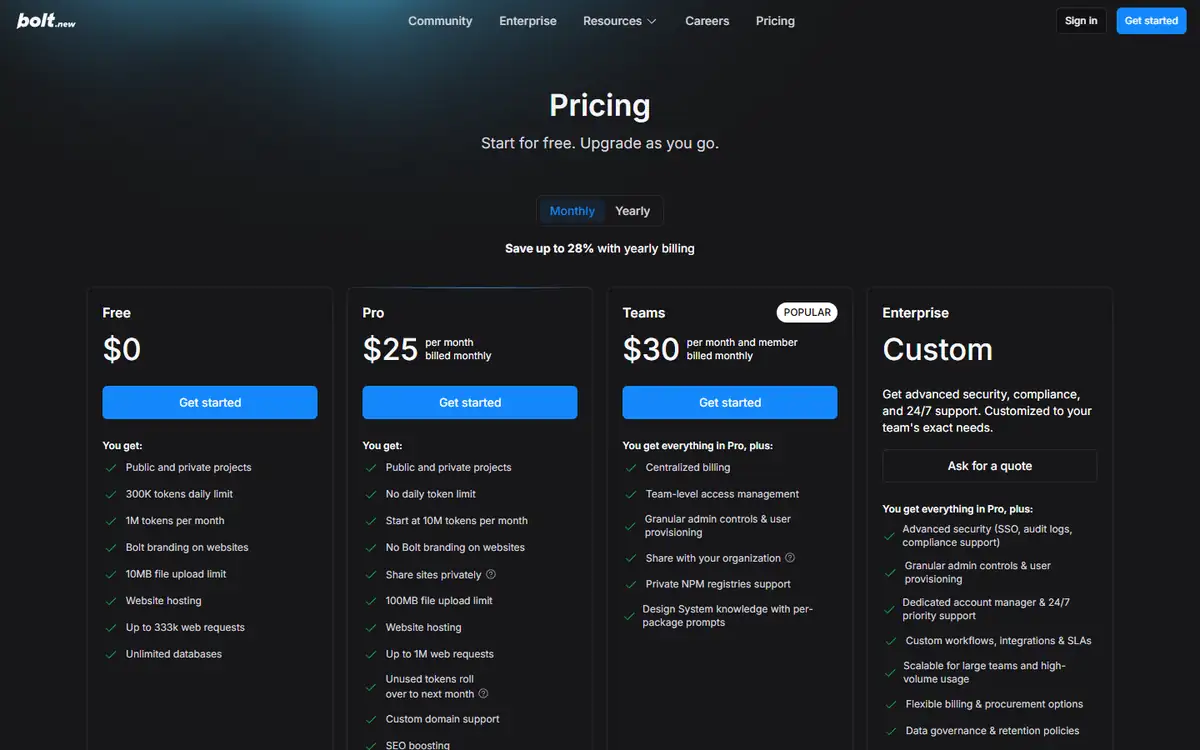
- Free plan includes public/private projects, hosting, databases, and one million monthly tokens.
- Pro removes daily token limits and branding while adding domains and larger uploads.
- Framework and database choice give technical teams more room.
Where Bolt fell short
- Larger projects consume more tokens because context must be synchronized.
- Free uploads are limited to 10 MB.
- Generated code can accumulate inconsistent patterns across many prompts.
- A browser-based environment does not replace production observability or security review.
I would choose Bolt when a developer owns the repository and treats AI output as code to review, test, and refactor.
Lovable vs Bolt edge case that changes the winner
Multi-tenant security changes the winner. A portal can look correct while a modified API request returns another client’s document.
The fix belongs in server authorization and database policy, not a hidden button or prompt telling the UI to behave.
| Failure point | Lovable | Bolt | Operational response |
|---|---|---|---|
| Cross-tenant direct request | Inspect generated policies and backend rules | Inspect code, query, and database enforcement | Bolt offers the clearer technical path |
| Nontechnical stakeholder owns iteration | Visual editing and guided stack reduce dependence | Code detail can overwhelm ownership | Lovable wins this edge |
| Project context becomes large | Complex prompts consume variable credits | File-system sync increases token use | Refactor before prompting more |
Add automated tenant-isolation tests before visual polish. Security regressions then fail visibly instead of hiding behind a successful demo.
Lovable vs Bolt workflow economics
I measured cost to the first secure workflow, then estimated monthly hosting, AI, developer review, and rework. First-pixel speed was only one line.
Lovable can lower product and design labor. Bolt can lower engineering diagnosis time. Both can increase rework if prompts substitute for architecture.
| Cost driver | Lovable | Bolt | What to measure |
|---|---|---|---|
| Prototype | Fast guided UI and backend path | Fast code-first generation | Hours to stakeholder-approved flow |
| Secure production | Requires policy and code review | Requires code, dependency, and infrastructure review | Engineer hours to pass test matrix |
| Usage unit | Credits across build, Cloud, and app AI | Tokens plus hosting/request limits | Cost after project context grows |
| Rework | Visual and generated changes can cross layers | Code drift accumulates across prompts | Defects per ten feature changes |
A $25 tool is expensive if it creates a week of authorization rework. Track engineering review from the first day.
Lovable vs Bolt quality controls that matter
I checked generated UI, accessibility, data boundaries, empty states, API errors, and the repository. A working happy path earned only partial credit.
Every feature needed a test and a source-of-truth owner. The AI’s summary of what it changed did not replace the code diff.
- Run cross-tenant, expired-session, and direct-request tests.
- Review code diffs and database migrations after every major prompt.
- Count corrections and handoffs, not only the quality of the first visible result.
- Repeat the least forgiving input before signing an annual contract.
The app is ready for users only when a fresh engineer can clone, configure, test, and deploy it without the chat history.
Lovable vs Bolt pricing and free access
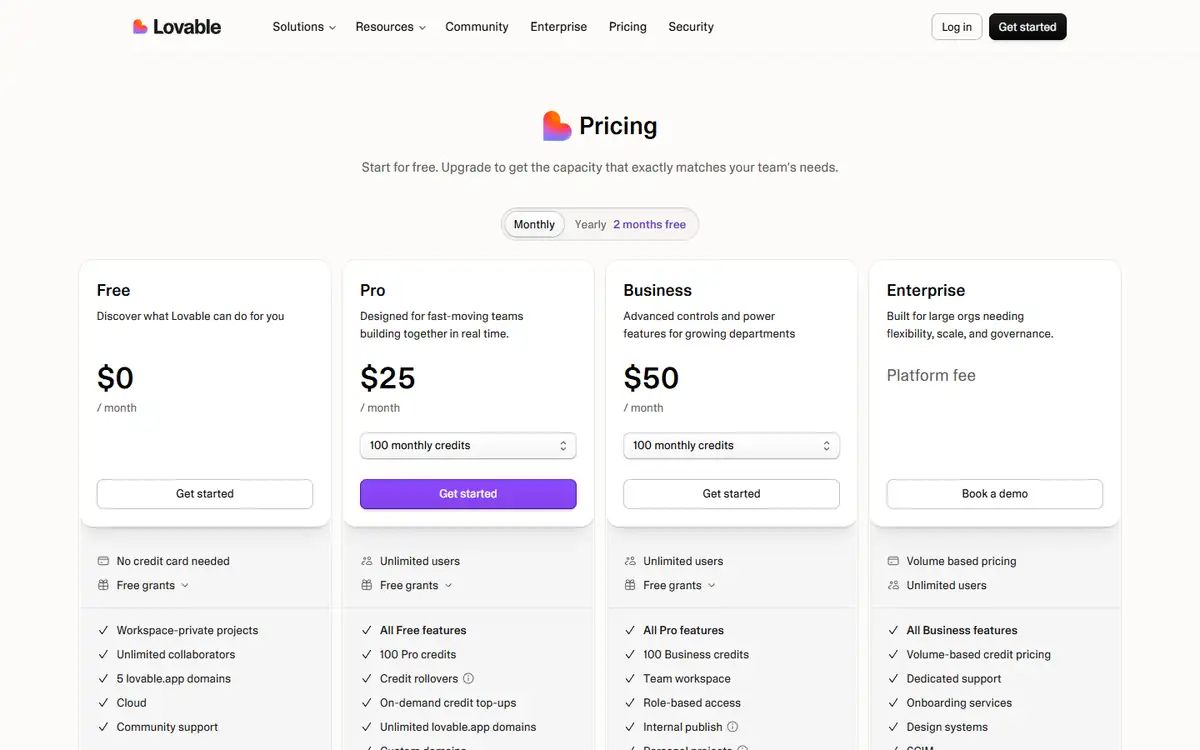
Lovable Free grants five daily build credits up to thirty monthly, plus Cloud and in-app AI grants. Paid workspaces share credits across unlimited members, and consumption varies by mode and task complexity.
Bolt Free includes 300,000 daily and one million monthly tokens, 10 MB uploads, hosting, and databases. Pro is $25 monthly with at least ten million tokens, larger uploads, custom domains, and no Bolt branding.
| Buying question | Lovable | Bolt | |
|---|---|---|---|
| Free prototype | Daily build and monthly Cloud grants | Daily/monthly tokens with hosting and databases | Both support a real pilot |
| Team billing | Shared workspace credits; no per-seat price | Teams is priced per member | Model collaboration style |
| Context growth | Complex tasks consume variable credits | Large project context consumes more tokens | Measure cost after ten features |
| Hosting | Included grants cover many small apps; larger use consumes balance | Requests and database capacity vary by plan | Forecast real traffic and storage |
Build the same secure vertical slice before annual commitment. The first screen hides the cost curve.
Lovable vs Bolt privacy and data handling
A client portal holds identity, files, business records, and authentication secrets. Prototype data should be synthetic until access controls are verified.
Code ownership does not automatically make hosted data handling acceptable. Review subprocessors, regions, retention, logs, and breach responsibilities.
- Never paste production secrets into a chat prompt.
- Use separate development and production databases with least-privilege keys.
- Test deletion and export with non-sensitive material before adding customer data.
- Save the policy version and plan name used for the decision.
Require a security review before migrating customer files or enabling external invitations.
Recheck the official Lovable page and the official Bolt page before uploading confidential material or paying. Product limits and policy language can change after this test date.
Switching between Lovable and Bolt
Both advertise code ownership and repository paths, but managed cloud resources, databases, auth, storage, and generated assumptions still create migration work.
A successful export must run outside the platform with documented environment variables and reproducible migrations.
- Sync to a repository on day one.
- Run the app in a fresh environment.
- Export schema and storage metadata.
- Document domains, secrets, and deployment dependencies.
The test of ownership is not downloading code; it is rebuilding the service without the original workspace.
Who should use Lovable or Bolt?
Lovable is best for
- Nontechnical founders and product managers
- Teams prioritizing polished prototypes
- Small apps that fit a guided managed stack
Bolt is best for
- Developers and technical founders
- Projects needing code and framework control
- Teams planning an engineering-owned handoff
Who should use neither tool
- Regulated production systems without professional security and legal review.
- Complex products whose architecture is not understood by anyone on the team.
- Teams that cannot keep a human approval step before a high-impact action or publication.
Choose Lovable when product iteration is the bottleneck and Bolt when technical ownership is the bottleneck.
Lovable vs Bolt: final buying decision
For a stakeholder prototype, I would choose Lovable and schedule engineering review before inviting customers.
For a portal a developer must maintain, I would choose Bolt, add tests immediately, and refactor after each major generated slice.
- Pick Lovable for guided product speed.
- Pick Bolt for code-level ownership.
- Test tenant isolation before polish.
- Prove the repository runs outside the builder.
Bolt wins the production-minded client portal test; Lovable remains the stronger option for a polished founder-led prototype.
For more hands-on comparisons, visit the AI tool comparisons hub.
Lovable vs Bolt FAQ
Is Lovable or Bolt better for beginners?
Lovable generally gives nontechnical users a more guided and visually oriented path.
Which is better for developers?
Bolt exposes more of the development environment and code, which helps technical debugging and handoff.
Can Lovable and Bolt build secure apps?
They can generate security-related code, but the team must verify authorization, secrets, dependencies, logging, and data handling.
Do I own the generated code?
Both provide code ownership or export paths under their stated terms, but hosted services and backend migration still require planning.
Next step
Build one secure vertical slice in both tools: invite, login, upload, cross-tenant denial, audit event, and repository setup. Count fixes after the demo, not before it.